Worksheets, workbooks, assessments, mind maps, checklists and planners — practical tools to learn and apply every strategy.
Worksheets, workbooks, assessments, mind maps, checklists and planners — practical tools to learn and apply every strategy.
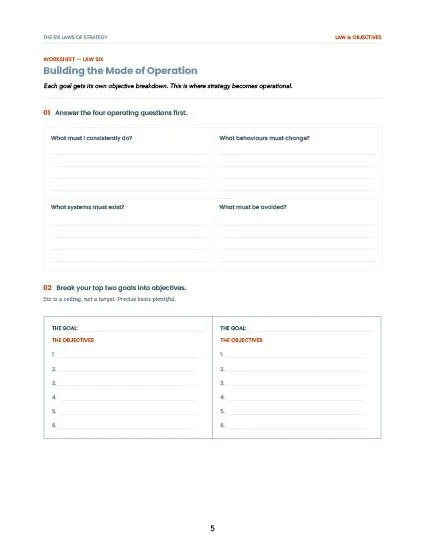
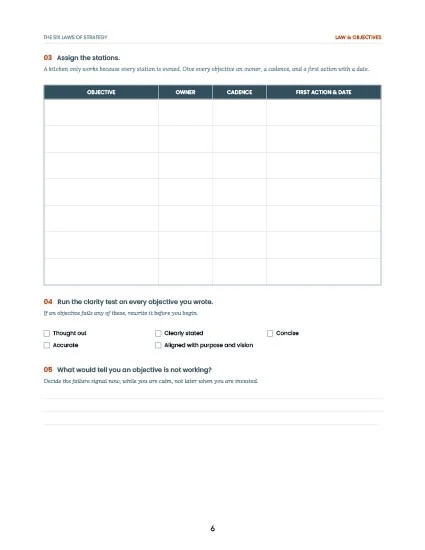
Format: PDF
Page Count: 5 (Not Including Cover)
Reference Guide & Worksheet
What This Is
The sixth and final law is where the whole system touches the ground. The problem was identified, the solution chosen, the purpose established, the vision written, the goals set — and none of it moves until somebody decides what will actually be done. This guide and worksheet are where that decision gets made, and written down where you can be held to it.
WHAT'S INSIDE
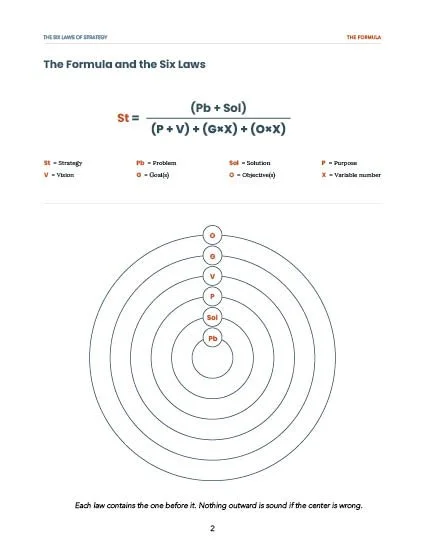
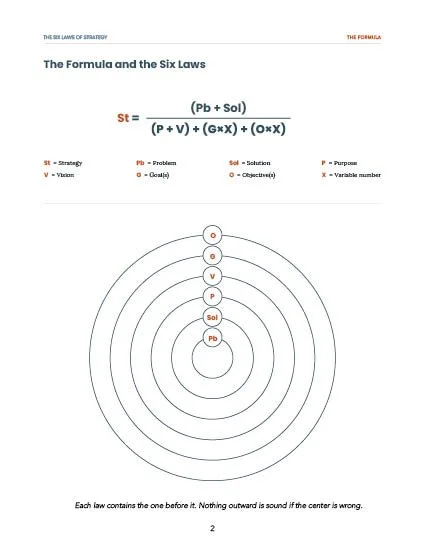
The Formula and the Six Laws (reference page)
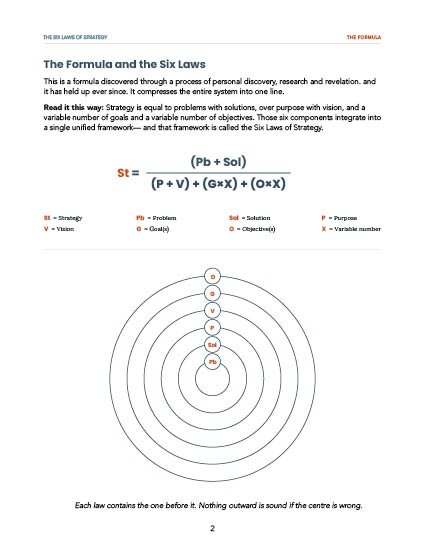
The complete strategy formula with every term defined, plus the concentric ring model showing how the six laws nest inside one another. Each law contains the one before it. Nothing outward is sound if the center is wrong.
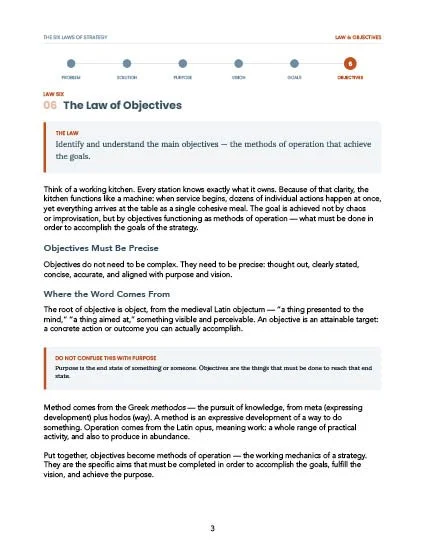
The Law of Objectives (two-page guide)
The law itself
The working kitchen
Objectives must be precise
Where the word comes from
Do not confuse this with purpose
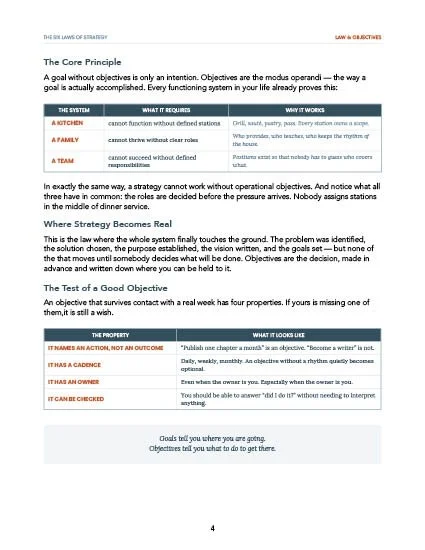
The core principle
The test of a good objective
Building the Mode of Operation (two-page worksheet)
FORMAT
8.5in × 11in, US Letter — prints on standard paper
6 pages, print-ready PDF, designed for handwriting
Law Six of the Six Laws of Strategy
WHO IT'S FOR
Anyone whose plan is sound and whose Monday looks identical to last Monday. Especially strong for teams — the stations table turns a shared goal into named ownership, which is usually the thing quietly missing.
HOW TO USE IT
The test on the guide page is the filter: if your objective names an outcome rather than an action, has no rhythm, has no owner, or can't be answered with a plain did I do it, rewrite it before you start. "Become a writer" fails all four. "Publish one chapter a month" passes.
WORKS BEST WITH
The Law of Goals (Law Five), which supplies the goals this worksheet breaks down. Objectives without goals are just a busy list.
Format: PDF
Page Count: 4 (Not Including Cover)
Reference Guide & Worksheet
What This Is
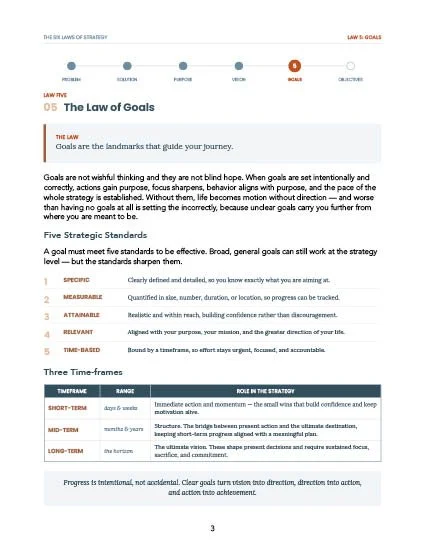
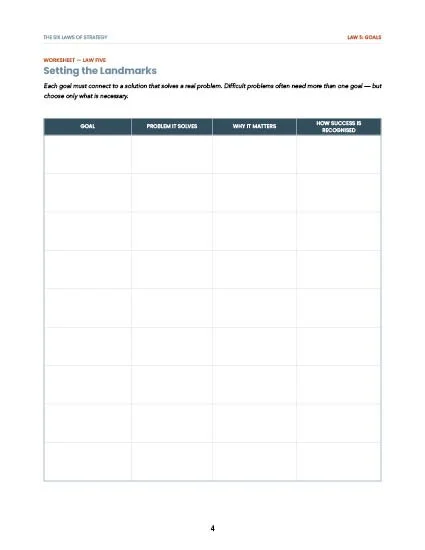
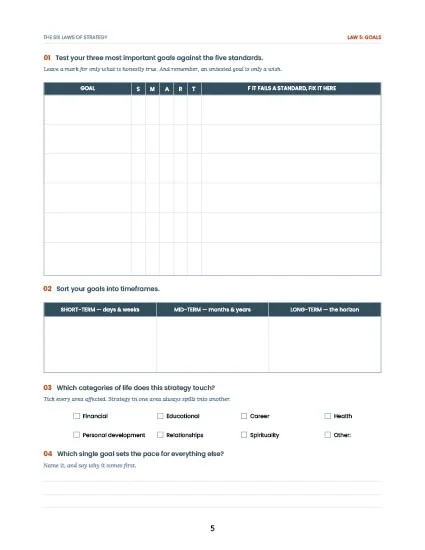
The fifth of the Six Laws is about setting landmarks that actually guide the journey. Five standards every goal has to survive, three timeframes that give a strategy its pace, and a worksheet that tests your goals instead of just recording them.
WHAT'S INSIDE
The Formula and the Six Laws (reference page)
The complete strategy formula with every term defined, plus the concentric ring model showing how the six laws nest inside one another. Each law contains the one before it. Nothing outward is sound if the center is wrong.
The Law of Goals (guide page)
The law itself
Five strategic standards
Three timeframes
The core teaching
Setting the Landmarks (two-page worksheet)
FORMAT
8.5in × 11in, US Letter — prints on standard paper
5 pages, print-ready PDF, designed for handwriting
Law Five of the Six Laws of Strategy
WHO IT'S FOR
Anyone who sets goals every January and cannot say by March which problem any of them was solving. Also strong for teams and annual planning — the goals table forces every milestone to justify itself against a real problem before it makes the list.
HOW TO USE IT
Question 1 is where this sheet does its real work. Most people have never run a goal through the five standards honestly, and the ones that fail tend to fail on Relevant — they're good goals that belong to somebody else's strategy. Fix them in the right-hand column rather than deleting them.
WORKS BEST WITH
The Law of Vision (Law Four), which supplies the future picture these landmarks are pointing toward, and The Law of Problems, which supplies the problems column.
Format: PDF
Page Count: 5 (Not Including Cover)
Reference Guide & Worksheet
What This Is
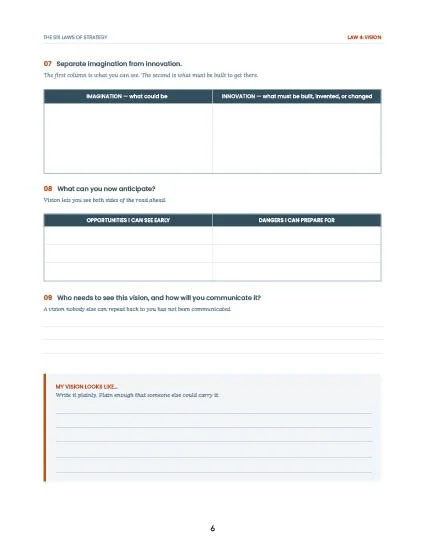
The fourth of the Six Laws is about seeing the end from the beginning, then writing it plainly enough that other people can carry it with you. A vision kept private is only a preference.
WHAT'S INSIDE
The Formula and the Six Laws (reference page)
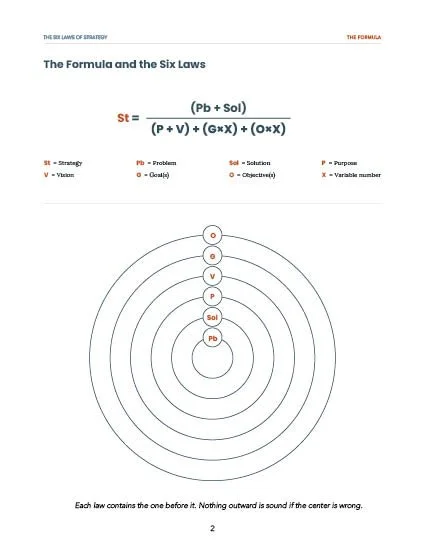
The complete strategy formula with every term defined, plus the concentric ring model showing how the six laws nest inside one another. Each law contains the one before it. Nothing outward is sound if the center is wrong.
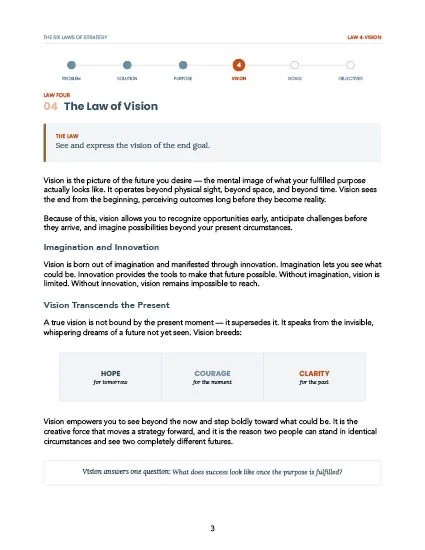
The Law of Vision (two-page guide)
The law itself
Imagination and innovation
What vision breeds
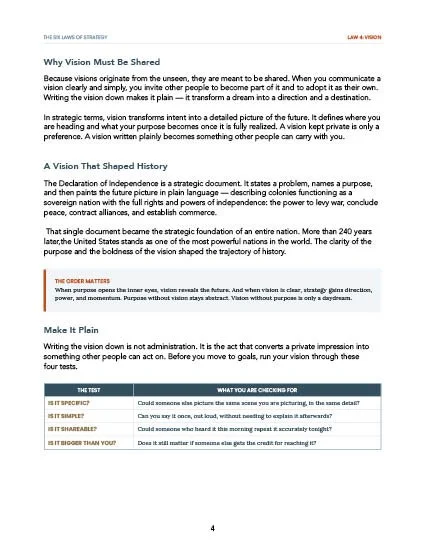
Why vision must be shared
A vision that shaped history
The order matters
Make it plain
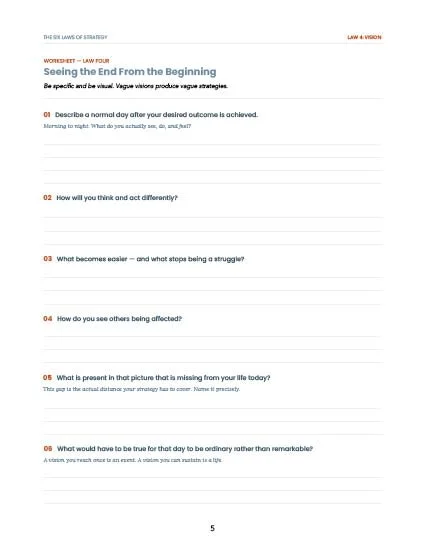
Seeing the End From the Beginning (two-page worksheet)
FORMAT
8.5in × 11in, US Letter — prints on standard paper
6 pages, print-ready PDF, designed for handwriting
Law Four of the Six Laws of Strategy
WHO IT'S FOR
Leaders, founders, ministry and nonprofit teams, and anyone whose team can recite the plan but not the point. Also useful for anyone writing a vision statement who wants something more rigorous than adjectives.
HOW TO USE IT
Question 5 is where this sheet earns its keep. The gap between the picture you just described and your life today is the actual distance your strategy has to cover — and most people have never measured it. Question 6 is the follow-on that separates a vision you reach once from one you can sustain.
WORKS BEST WITH
The Law of Purpose (Law Three), which supplies the purpose this vision is a picture of. Vision without purpose is only a daydream, and this worksheet assumes you've already done that work.
Format: PDF
Page Count: 5 (Not Including Cover)
Reference Guide & Worksheet
What This Is
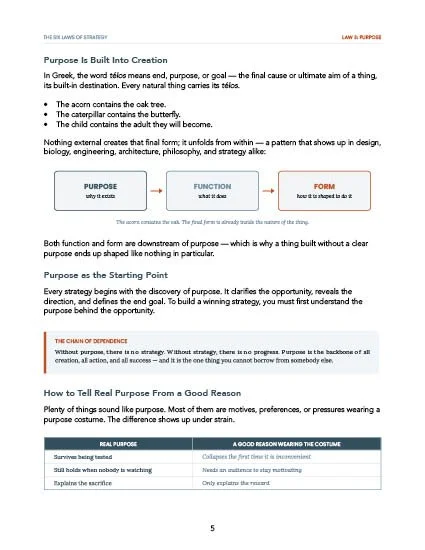
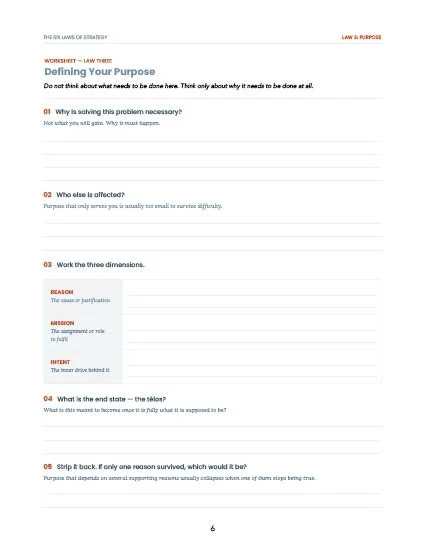
Most people think they have a purpose. What they usually have is a motive wearing a purpose costume, and the difference doesn't show up until something goes wrong. This guide teaches you to tell them apart, then hands you a nine-question worksheet that strips your reasons down to the one that would survive alone.
WHAT'S INSIDE
The Formula and the Six Laws (reference page)
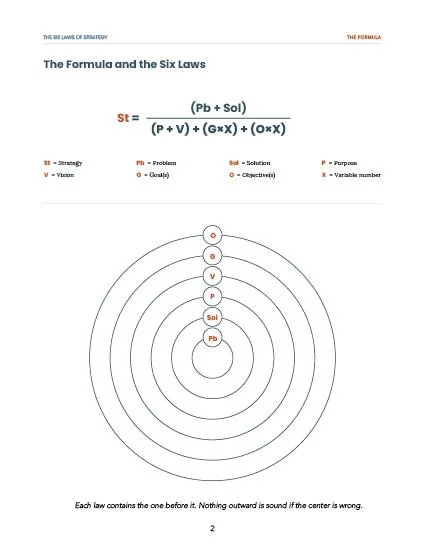
The complete strategy formula with every term defined, plus the concentric ring model showing how the six laws nest inside one another. Each law contains the one before it. Nothing outward is sound if the center is wrong.
The Law of Purpose (two-page guide)
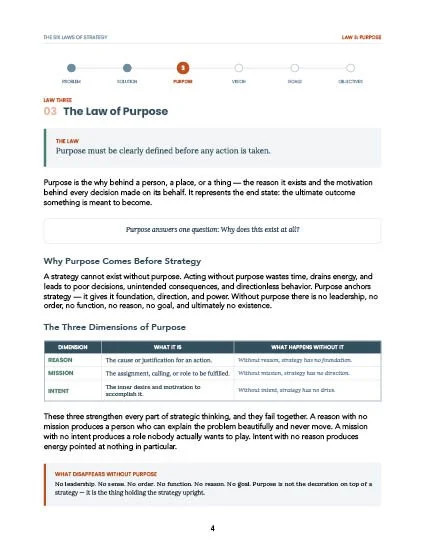
The law itself
Why purpose comes before strategy
The three dimensions
Purpose is built into creation
Purpose → Function → Form
How to tell real purpose from a good reason
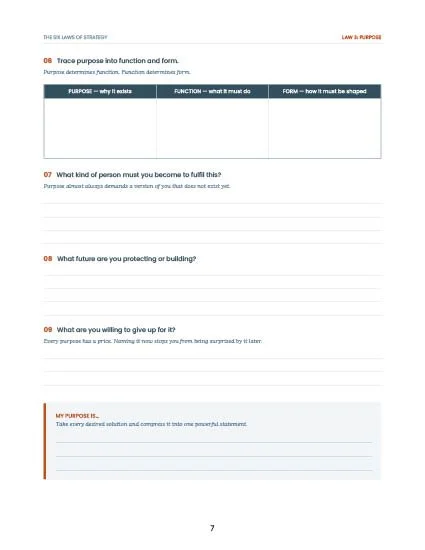
Defining Your Purpose (two-page worksheet)
FORMAT
8.5in × 11in, US Letter — prints on standard paper
6 pages, print-ready PDF, designed for handwriting
Law Three of the Six Laws of Strategy
WHO IT'S FOR
Leaders, founders, ministry and nonprofit teams, and anyone who has been busy and productive for a long stretch without being able to say what it was all for. Also useful for organisations writing or rewriting a mission statement — questions 1 through 5 do most of that work.
HOW TO USE IT
Question 5 is the sharp one, and it's the reason to do this on paper rather than in your head. Most people list four or five reasons and discover that only one of them would hold if the others stopped being true. That one is the purpose. The rest were support beams.
WORKS BEST WITH
The Law of Problems and The Law of Solutions, which supply the root cause and chosen solution this law gives a reason to.
Format: PDF
Page Count: 5 (Not Including Cover)
Reference Guide & Worksheet
What This Is
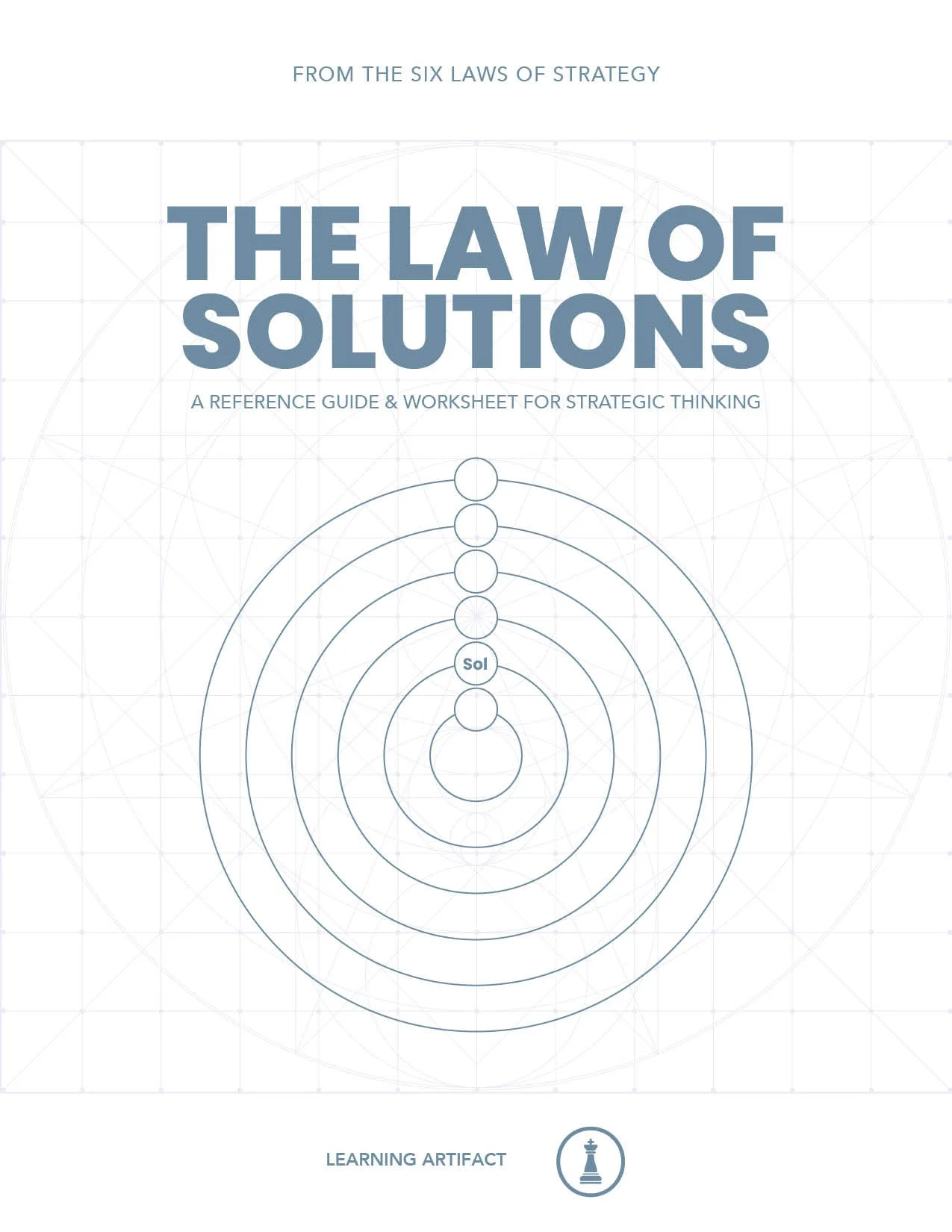
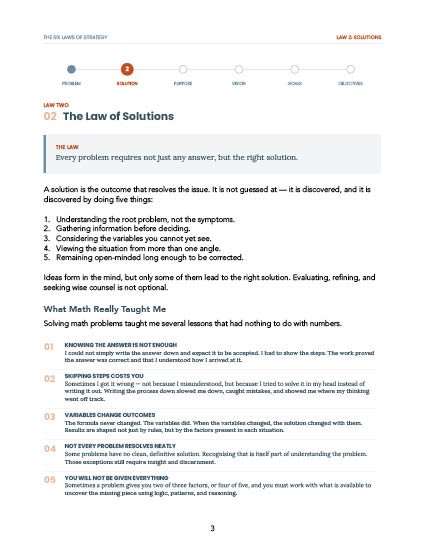
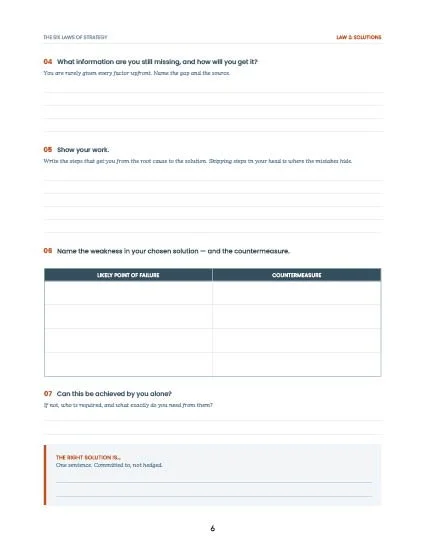
The second of the Six Laws is about discovering the right solution rather than guessing at one. This guide covers how solutions are actually found, why every one of them has a weakness, and the failure mode that catches careful people: analysis becoming a substitute for the decision. Then a two-page worksheet walks a real solution all the way to commitment.
WHAT'S INSIDE
The Formula and the Six Laws (reference page)
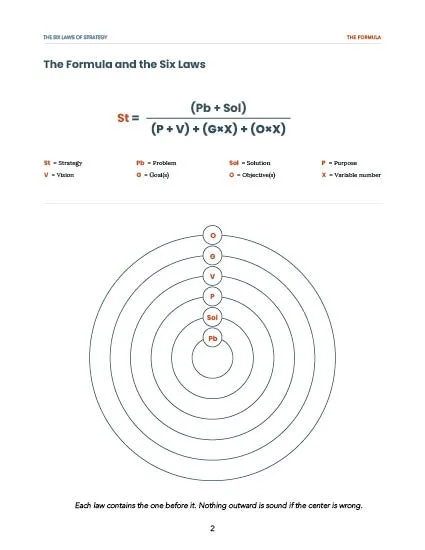
The complete strategy formula with every term defined, plus the concentric ring model showing how the six laws nest inside one another. Each law contains the one before it. Nothing outward is sound if the center is wrong.
The Law of Solutions (two-page guide)
The law itself
What math really teaches us
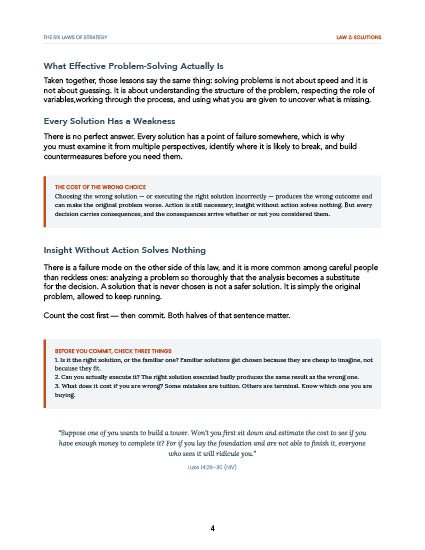
What effective problem-solving actually is
Every solution has a weakness
The cost of the wrong choice
Insight without action solves nothing
Three checks before you commit
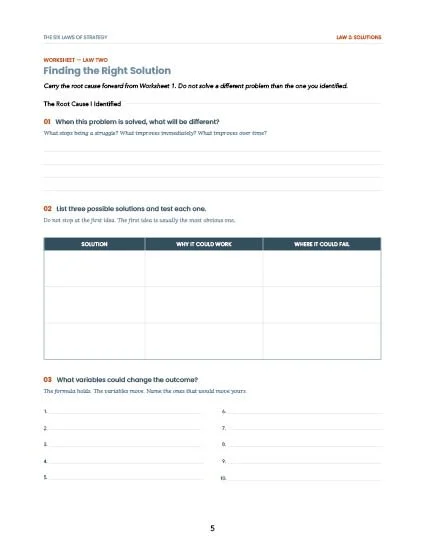
Finding the Right Solution (two-page worksheet)
FORMAT
8.5in × 11in, US Letter — prints on standard paper
5 pages, print-ready PDF, designed for handwriting
Law Two of the Six Laws of Strategy
WHO IT'S FOR
Anyone who keeps choosing solutions that seem sound and then break in month three. Also valuable for teams — the two tables turn "I have a bad feeling about this" into a specific, discussable point of failure.
HOW TO USE IT
This sheet assumes you already have a root cause. Carry it forward from The Law of Problems and write it in the box at the top. Do not solve a different problem than the one you identified — that substitution is the single most common way this law gets broken.
WORKS BEST WITH
The Law of Problems (Law One), which produces the input this worksheet requires, and The Principle of Strategy, Parts 1–3.
Format: PDF
Page Count: 5 (Not Including Cover)
Reference Guide & Worksheet
What This Is
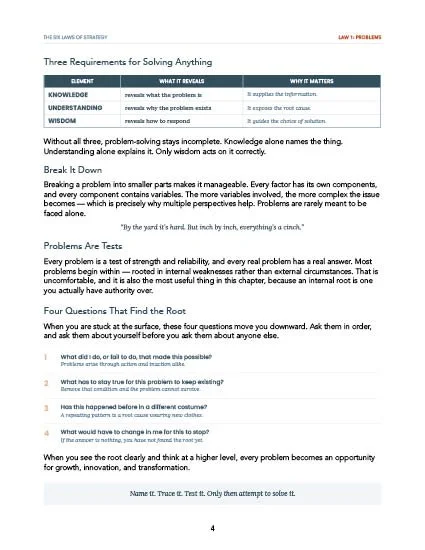
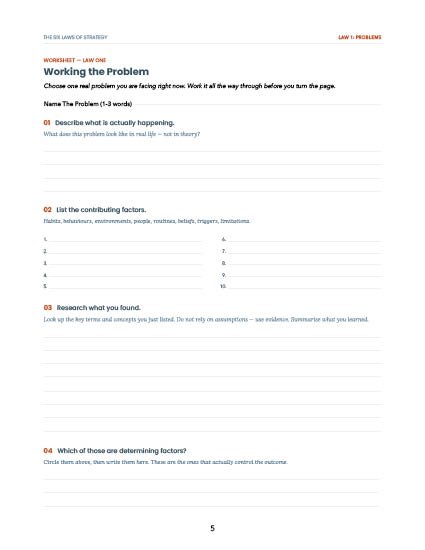
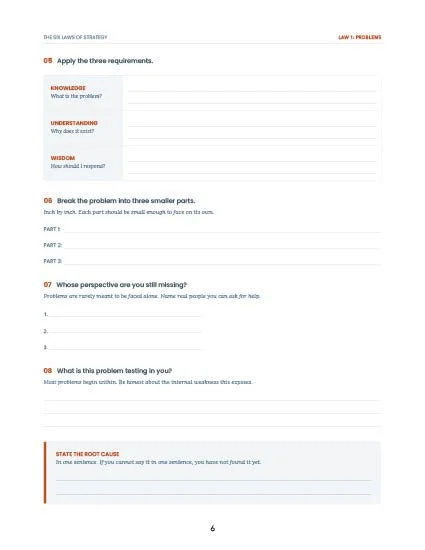
The first of the Six Laws is about seeing clearly before you attempt to fix anything. This guide teaches you to separate surface causes from the one underneath that actually controls the outcome, then gives you a two-page worksheet to run a real problem through — one you're facing right now, not a hypothetical one.
WHAT'S INSIDE
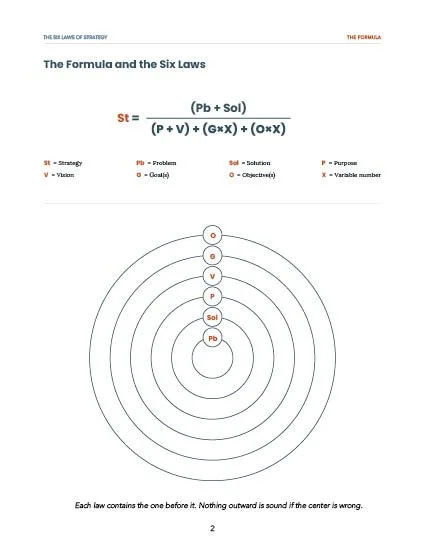
The Formula and the Six Laws (reference page)
The complete strategy formula with every term defined, plus the concentric ring model showing how the six laws nest inside one another. Each law contains the one before it. Nothing outward is sound if the center is wrong. Keep this page even after you've worked the sheet.
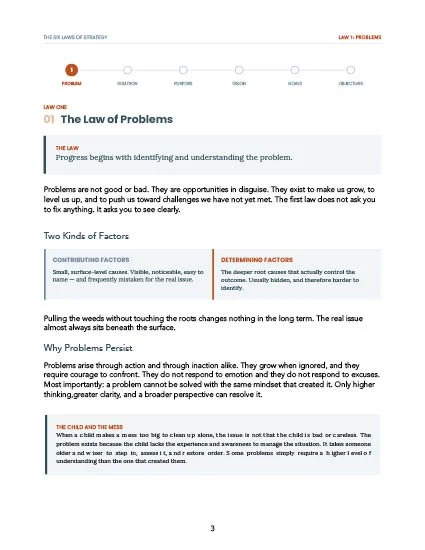
The Law of Problems (two-page guide)
The law itself
Two kinds of factors
Why problems persist
The child and the mess
Three requirements for solving anything
Four questions that find the root
Working the Problem (two-page worksheet)
FORMAT
8.5in × 11in, US Letter — prints on standard paper
5 pages, print-ready PDF, designed for handwriting
Law One of the Six Laws of Strategy
WHO IT'S FOR
Leaders, founders, ministry and nonprofit teams, and anyone who keeps solving the same problem twice. Also strong for team sessions — the contributing-versus-determining distinction gives a group fast, unemotional language for a disagreement about causes.
HOW TO USE IT
Read the guide pages once without a pen. Then pick one real problem — something currently costing you time, money, or peace — and work the sheet all the way through in a single sitting. Allow forty-five minutes. Question 8 is the one most people want to skip, and it's the one that pays.
WORKS BEST WITH
The Principle of Strategy, Parts 1–3, which establish the foundation this law builds on.
Format: PDF
Page Count: 2 (Not Including Cover)
Worksheet
What This Is
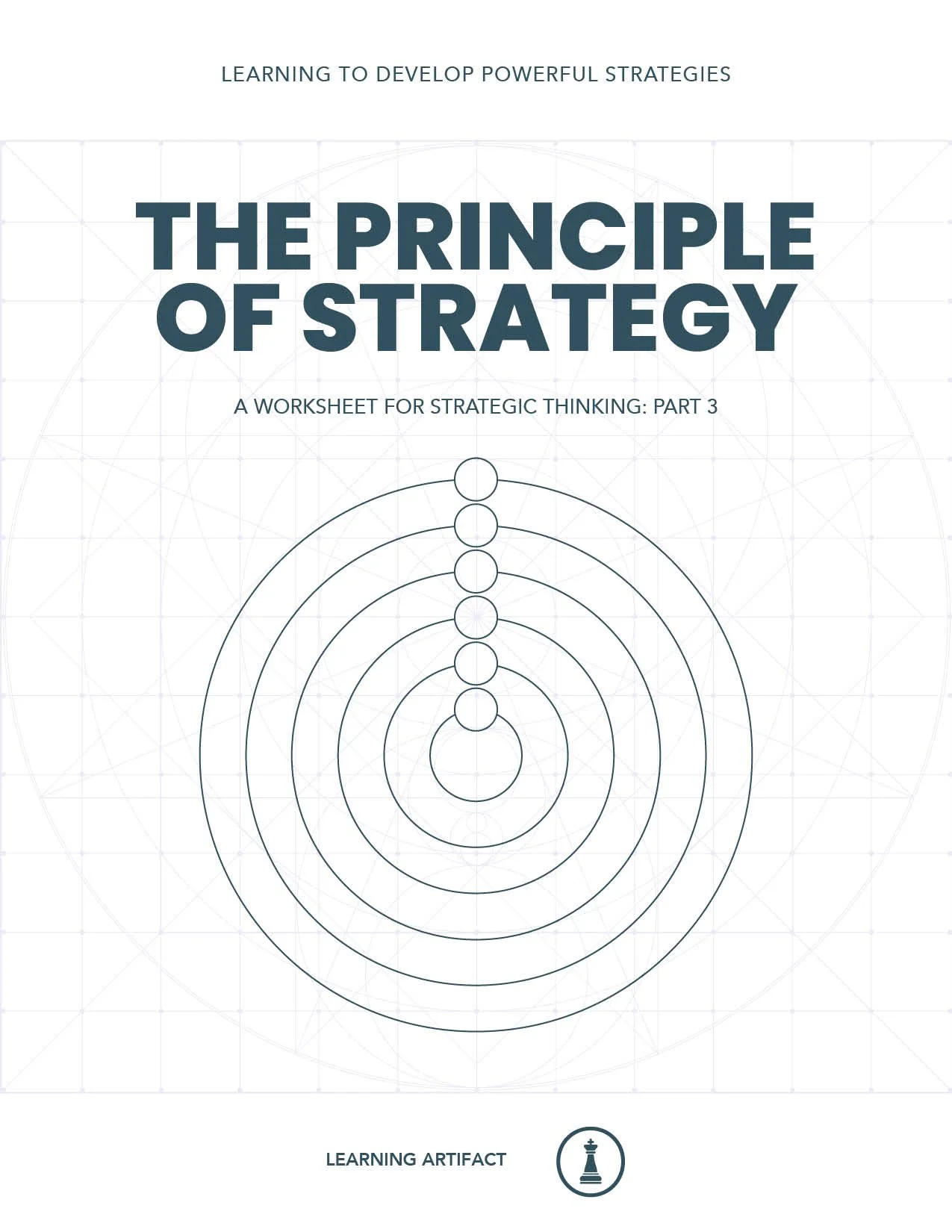
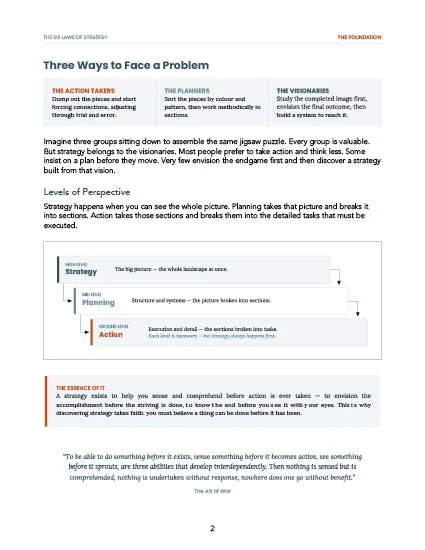
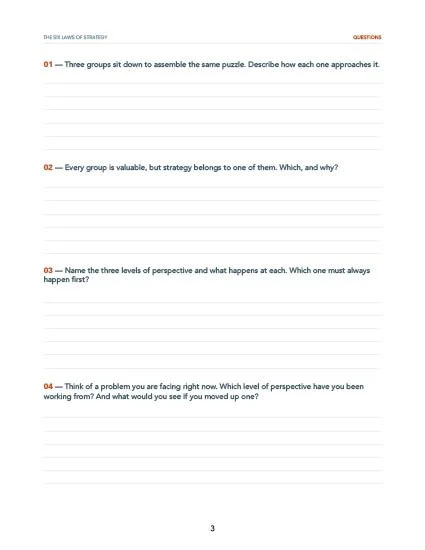
Part 3 is about the difference — and about the altitude problem underneath it. Most people try to solve problems from ground level, where every detail is visible and none of the shape is. One teaching page, four questions, and a final prompt that asks you to identify which level you've been stuck on.
WHAT YOU'LL WORK THROUGH
The teaching page — The Foundation
The jigsaw puzzle
The honest math of it
Levels of Perspective
The essence of it
Closing quote from The Art of War
FORMAT
8.5in × 11in, US Letter — prints on standard paper
Print-ready PDF, designed for handwriting
Part 3 of the Learning to Develop Powerful Strategies series
WHO IT'S FOR
Anyone who is genuinely working hard on a problem and getting nowhere. Usually that isn't an effort problem — it's an altitude problem. Also strong for team sessions: the three puzzle groups give people fast, non-defensive language for how they each default to working.
WORKS BEST WITH
Part 1 (What Strategy Actually Is) and Part 2 (Strategy, Plan, and Action), which establish the definitions this sheet builds on. Part 3 is where the framework starts pointing back at the reader.
Format: PDF
Page Count: 2 (Not Including Cover)
Worksheet
What This Is
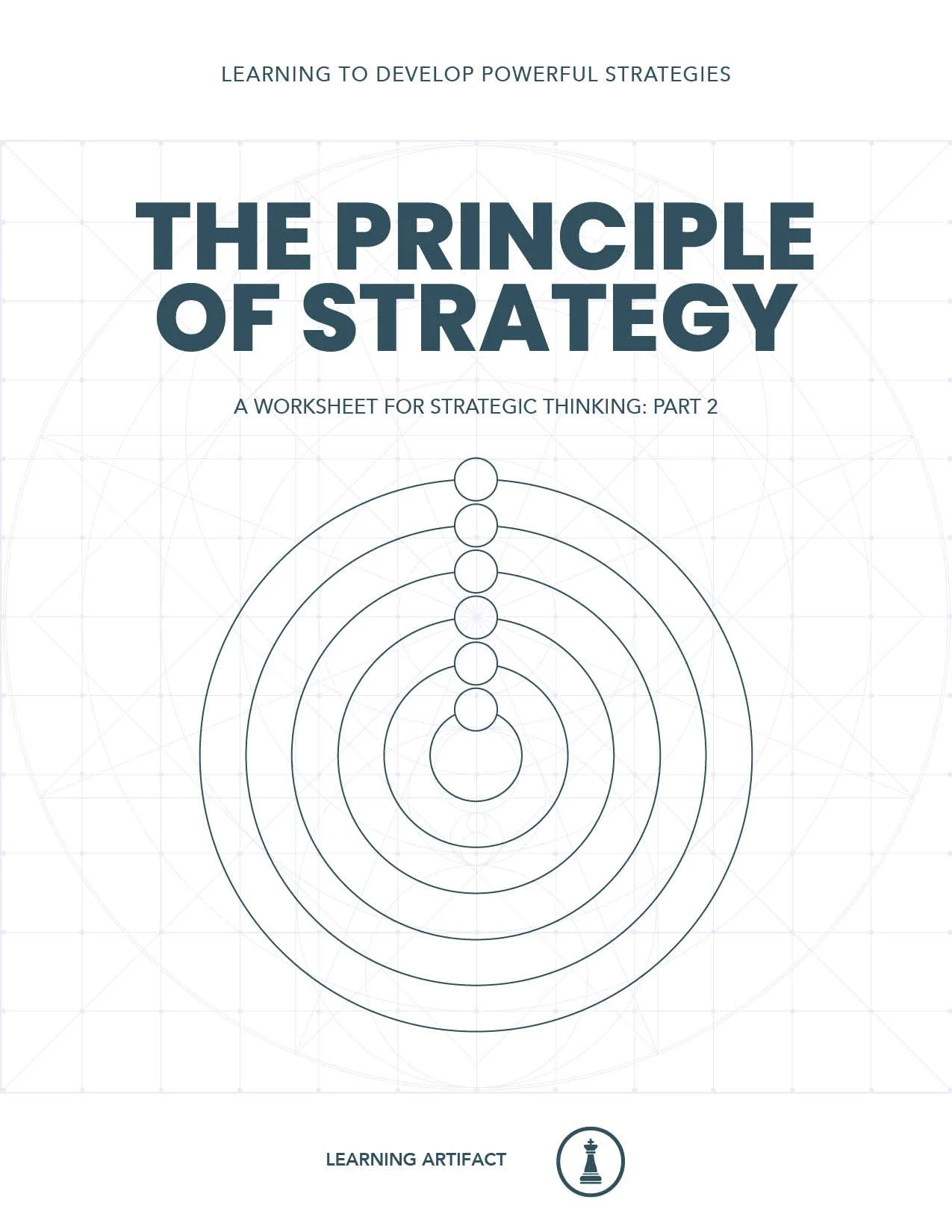
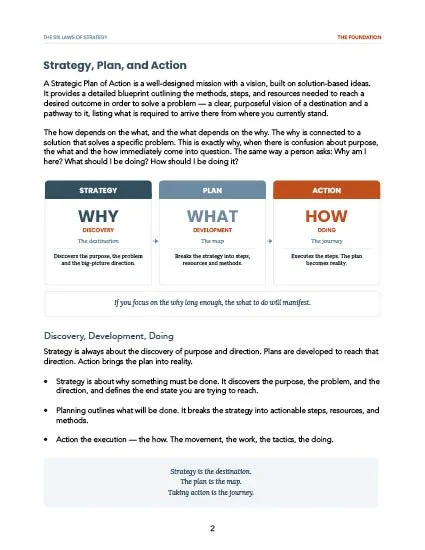
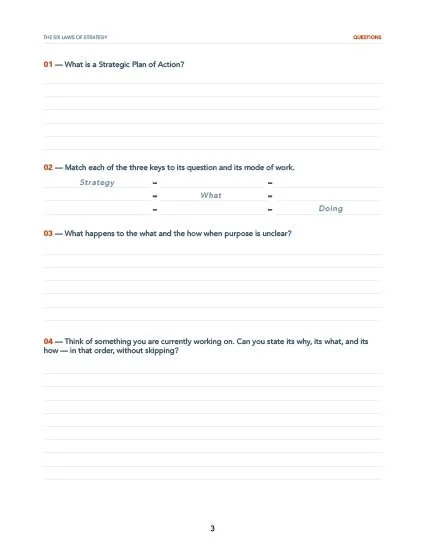
Strategy, plan, and action are three different jobs, and most people collapse them into one. Part 2 sorts out the confusion. One teaching page separating strategy, plan, and action into three distinct jobs, then four questions that check whether the distinction actually landed — including one that turns it on something you're working on right now.
WHAT YOU'LL WORK THROUGH
The teaching page — The Foundation
The Strategic Plan of Action, defined
The dependency chain
The three keys, side by side
Discovery, Development, Doing
FORMAT
8.5in × 11in, US Letter — prints on standard paper
Print-ready PDF, designed for handwriting
Part 2 of the Learning to Develop Powerful Strategies series
WHO IT'S FOR
Leaders, founders, ministry and nonprofit teams, and anyone who keeps busy without moving — the classic symptom of a how running without a why underneath it. Also works well for team sessions, where the matching grid makes a quick shared-language exercise.
WORKS BEST WITH
Part 1, What Strategy Actually Is, which defines the term this sheet builds on. They can be done in either order, but the sequence rewards you.
Format: PDF
Page Count: 2 (Not Including Cover)
Worksheet
What This Is
Most people can use the word strategy fluently and still not be able to define it. That gap is expensive, because everything built on a fuzzy definition inherits the fuzziness. This worksheet closes it.
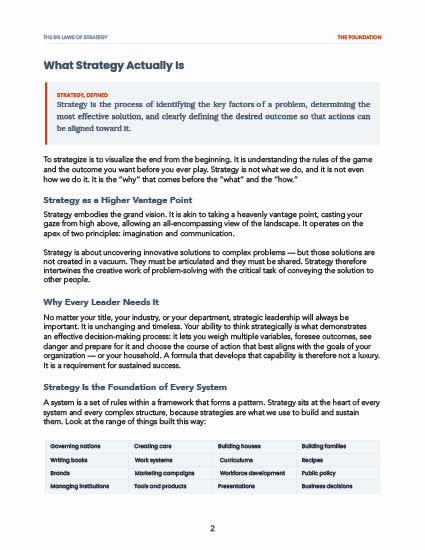
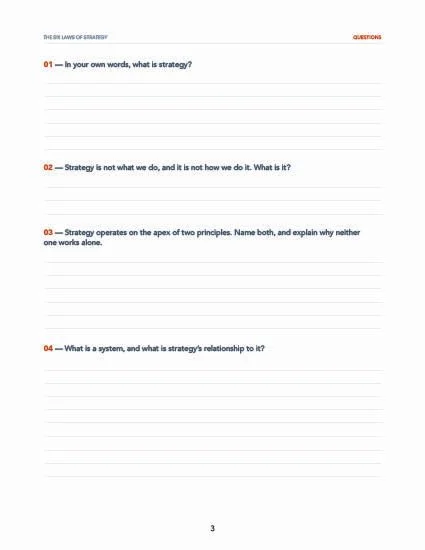
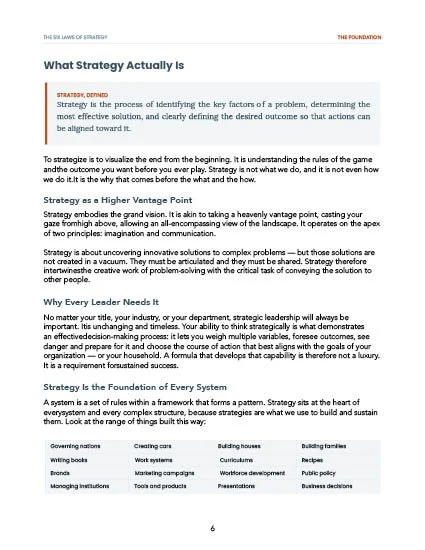
Part 1 covers one idea, thoroughly: what strategy actually is. You read a single focused teaching page, then answer four questions that test whether it stayed with you. No filler, no exercises you'll skip. Twenty minutes, one pen, one clear definition you'll carry into everything after it.
WHAT YOU'LL WORK THROUGH
The teaching page — The Foundation
Strategy, defined
Strategy as a higher vantage point
Why every leader needs it
Strategy as the foundation of every system
FORMAT
8.5in × 11in, US Letter — prints on standard paper
Print-ready PDF, designed for handwriting
Part 1 of the Learning to Develop Powerful Strategies series
WHO IT'S FOR
Anyone who leads something — a team, a company, a ministry, a household — and wants the foundation nailed down before building anything on top of it. Also a clean starting point for study groups, onboarding, and classroom use.
HOW TO USE IT
Read the page once without a pen. Read it again slowly. Then cover it and answer the four questions from memory. If you can't answer question 2, go back — the rest of the series depends on it.
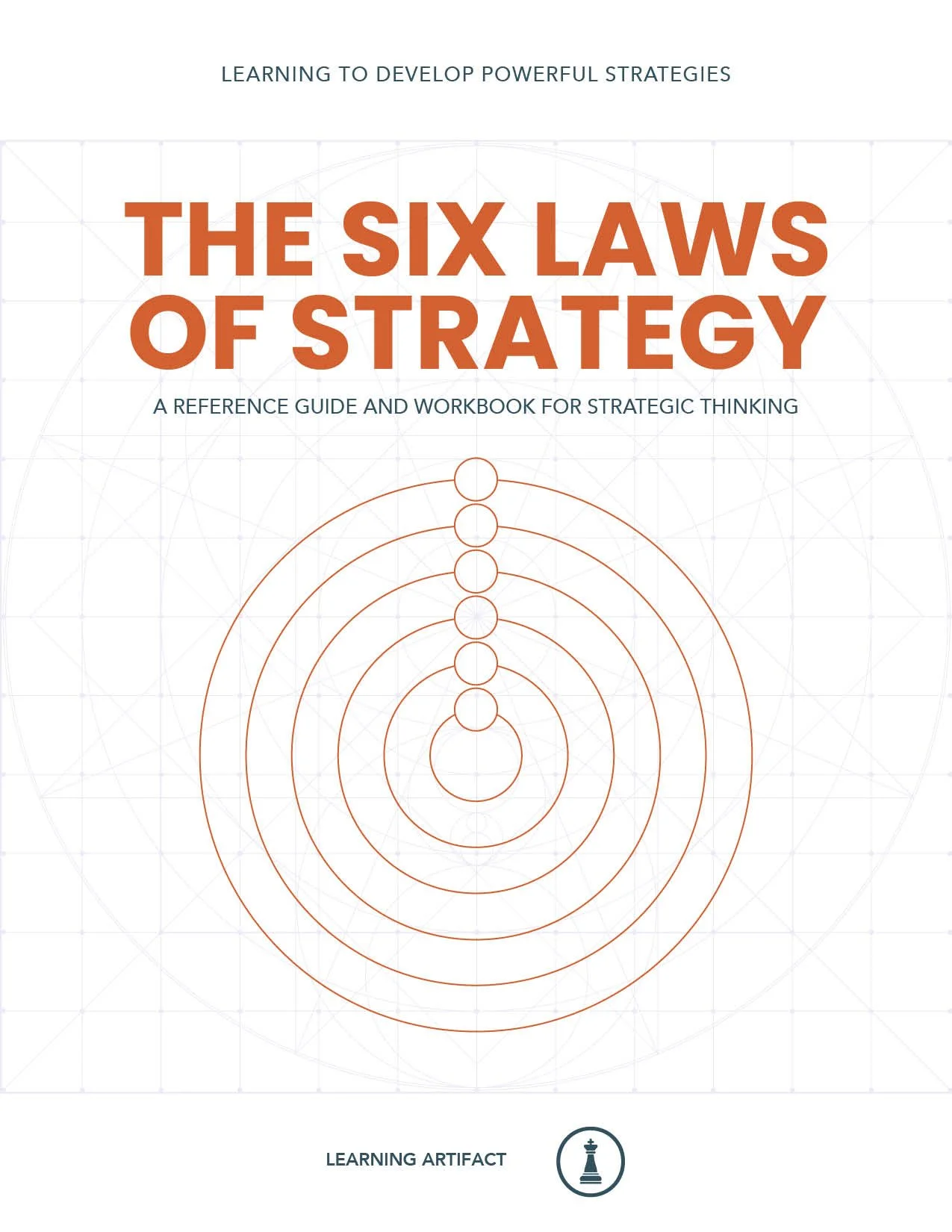
Format: PDF
Page Count: 37 (Not Including Cover)
Reference Guide & Workbook
What This is
Most people take action and think less. Some insist on a plan before they move. Very few see the end from the beginning and build a strategy from that vision.
This workbook is for the third group — or for anyone who wants to become part of it.
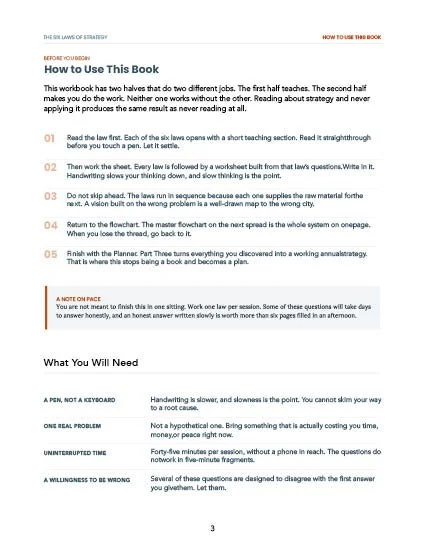
Strategy is not what you do, and it is not how you do it. It is the why that comes before both. This book breaks that why into six sequential laws, teaches each one, and then hands you a worksheet that makes you apply it to a problem you are actually facing.
WHAT'S INSIDE
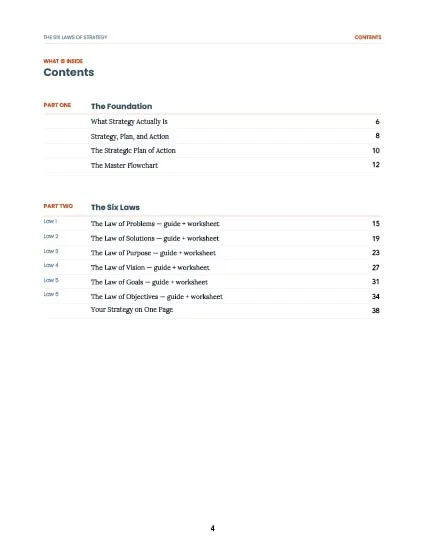
Part One — The Foundation
Before the six laws can be applied, the ground they stand on has to be understood.
What strategy actually is, and why it is unchanging and timeless regardless of your title or industry
Strategy, Plan, and Action — the three keys, the questions each one answers, and why the how always depends on the what, and the what on the why
Three ways to face a problem, and why strategy belongs to the visionaries
The three levels of perspective: high, mid, and ground — and why strategy must always come first
The Master Flowchart — the entire system on a single page, grouped into Discovery, Direction, and Operation
The Concentric Model — the six laws as expanding rings, each one containing the last
Part Two — The Six Laws
Each law gets a teaching section, then a two-page worksheet built from it. A progress indicator shows you exactly where you are in the sequence.
Closing: Your Strategy on One Page — a transfer sheet that compresses all six worksheets into a single working document.
FORMAT
8.5in × 11in, US Letter — prints on standard paper
38 pages, print-ready PDF
Designed for handwriting, with ruled response space, structured tables, and checklists throughout
WHO IT'S FOR
Leaders, founders, ministry and nonprofit teams, parents building a household, and anyone who keeps solving the same problem twice because they never found the root the first time.
Format: PDF
Page Count: 17 (Not Including Cover)
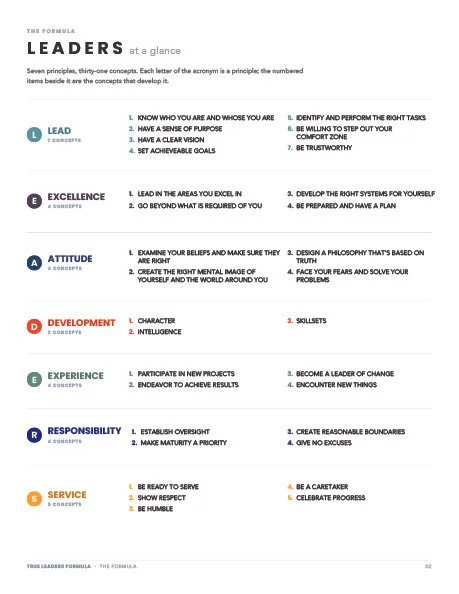
A system for developing true leaders — seven principles, thirty-one concepts, and a self-assessment that shows you exactly where to start.
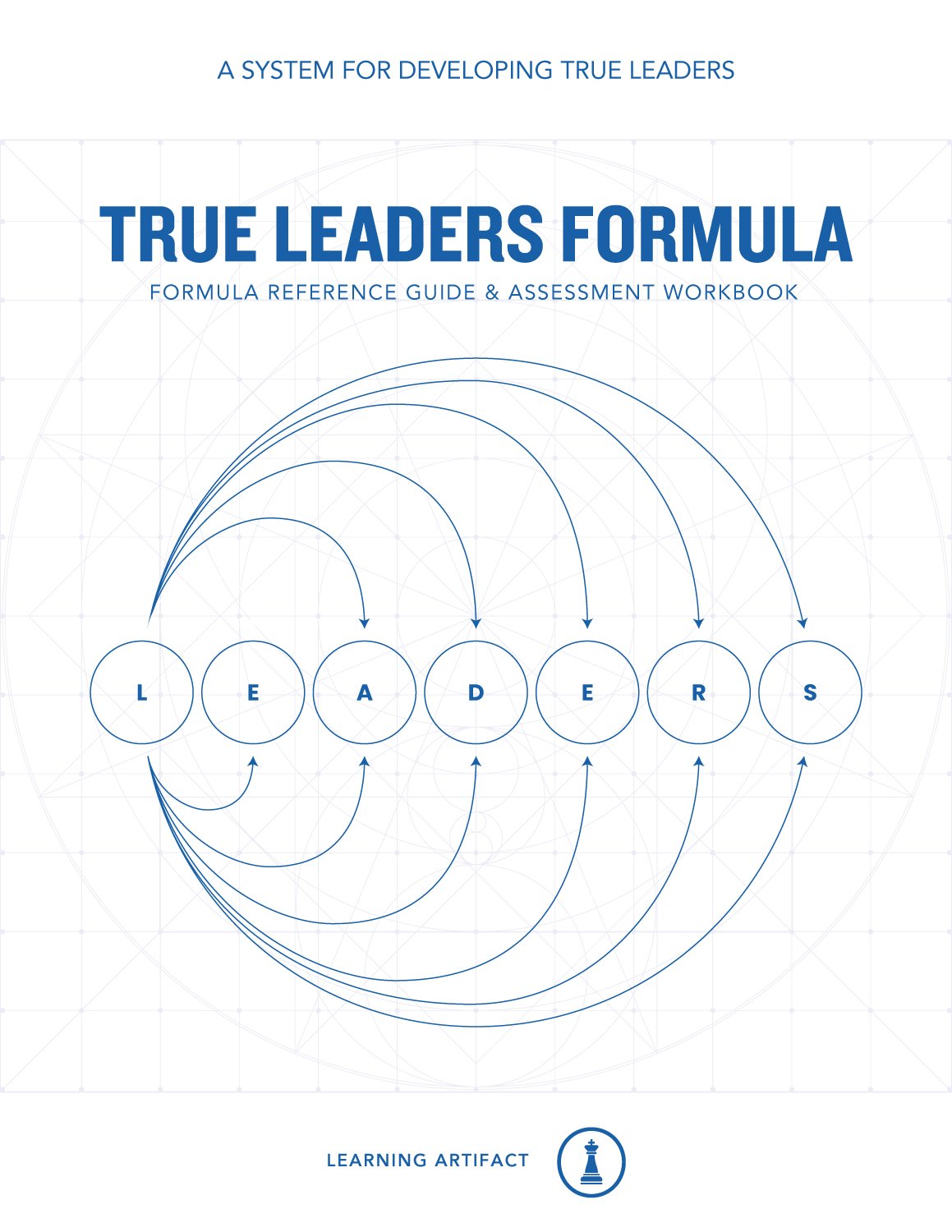
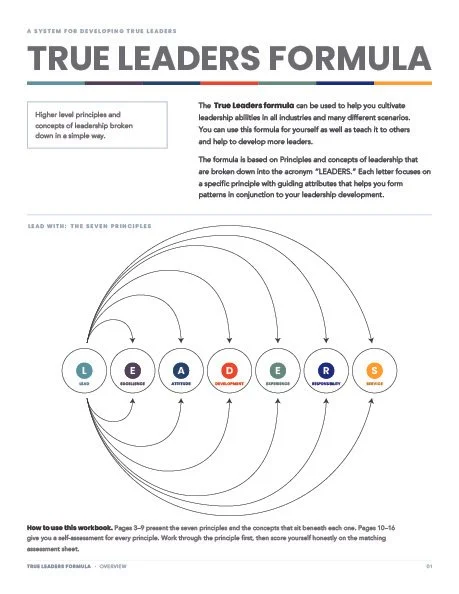
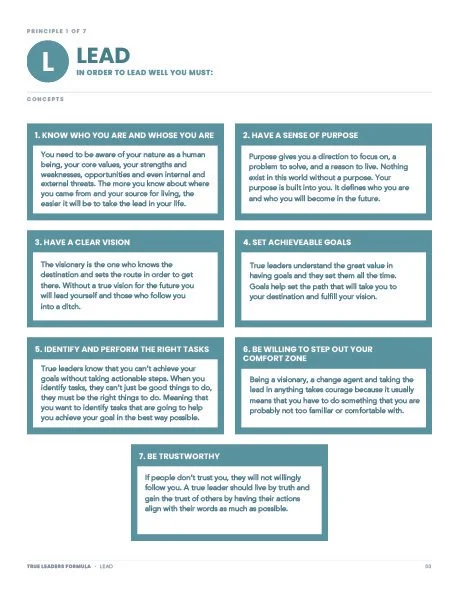
The True Leaders Formula takes leadership apart and gives you the pieces. Seven principles, built on the acronym LEADERS — Lead, Excellence, Attitude, Development, Experience, Responsibility, Service. Beneath each principle sit the specific concepts that develop it: thirty-one in all, each one explained in plain language on a single page you can sit with.
Then it asks you to be honest.
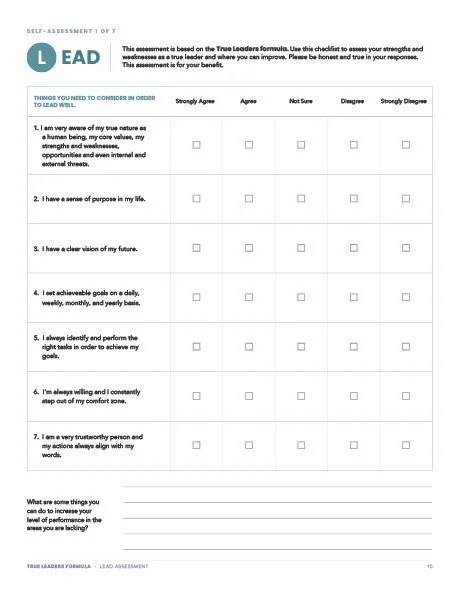
Every principle has its own self-assessment sheet. Thirty-one statements, scored one to five, with space to write what you'll do about the gaps you find. A final tally page pulls all seven sections into one score out of 155 and a leadership profile you shade in by hand. Your shortest column is your answer to the question most people never get a straight answer to: what should I work on first?
It works for you, and it works for the people you lead. The formula was built to be taught as easily as it's applied — take yourself through it, then take your team, your students, or your mentees through it.
Print it, fill it in, and come back to it in six months to see what moved.
Anyone who wants a structured, honest read on their own leadership
Managers and team leads developing people under them
Coaches, mentors, and facilitators who need a framework they can teach
Youth leaders, ministry leaders, and educators building leadership in others
Students and early-career professionals laying a foundation before they're handed a title
Format: PDF
Page Count: 4 (Not including Cover)
Group Activity Guide
What This Is
Every journey needs a place to land.
Not a finish line. Not a graduation. Not a moment where everything is suddenly resolved and the questions stop coming. But a place — a posture, a practice, a declaration — from which a person can look back at everything they have walked through and forward at everything that is still possible, and say with honesty and with weight: I know who I am. I know where I come from. And I am not going back to who I was before I knew.
Part 6 of the I Am Who I Am series is that place.
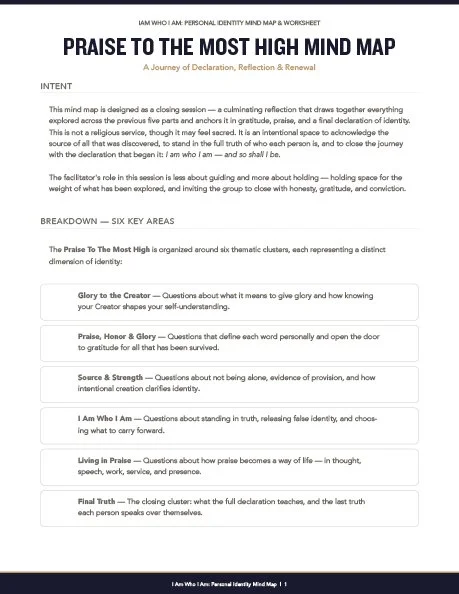
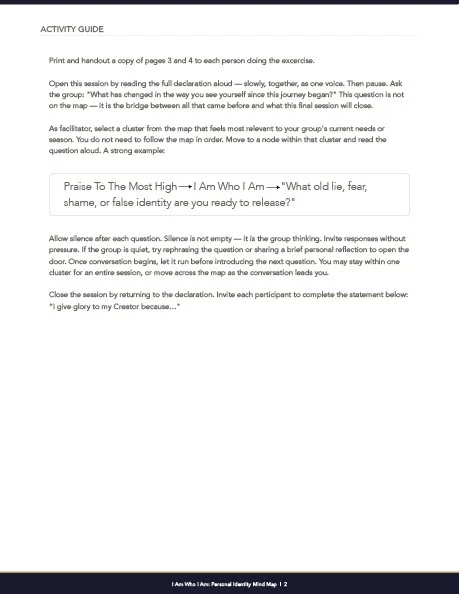
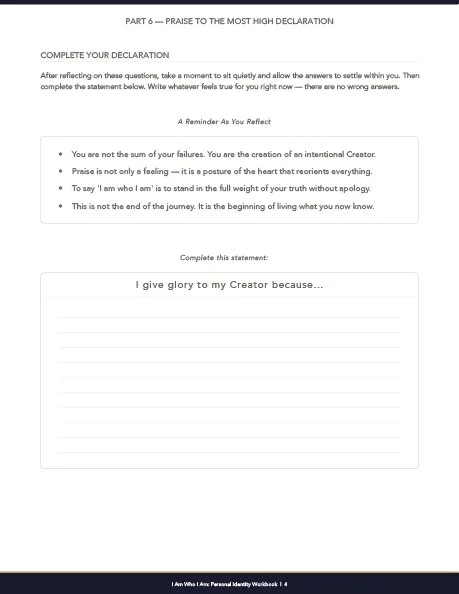
This is the closing session of the journey — a culminating group facilitation experience that draws together everything explored across the previous five parts and anchors it in the most grounding act available to a human being: gratitude, praise, and a final, unqualified declaration of identity. It does not introduce a new framework. It does not add another layer of content. It invites the group to stand fully in what has already been discovered — and to close the journey not with a summary, but with a declaration spoken from the deepest part of who they now understand themselves to be.
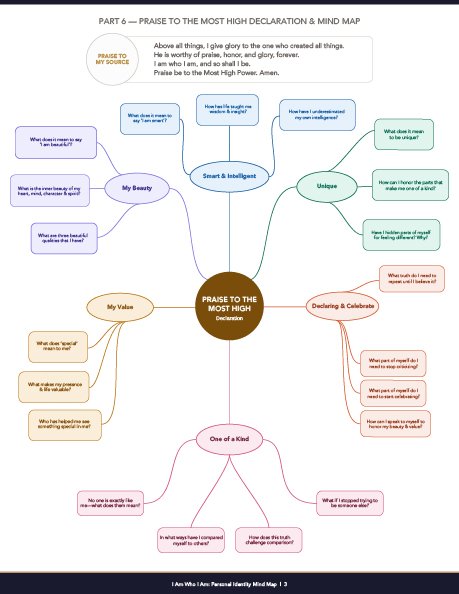
The Part 6 bundle includes a Mind Map for group facilitation and a Reflection Worksheet for personal written exploration. Together they form a complete guided closing experience — one that moves a group from the accumulated weight of everything they have examined across this series into the grounded, open-handed, clear-eyed posture of a person who has done the work, faced the truth, and chosen to stand in it.
The Mind Map — Group Facilitation Tool
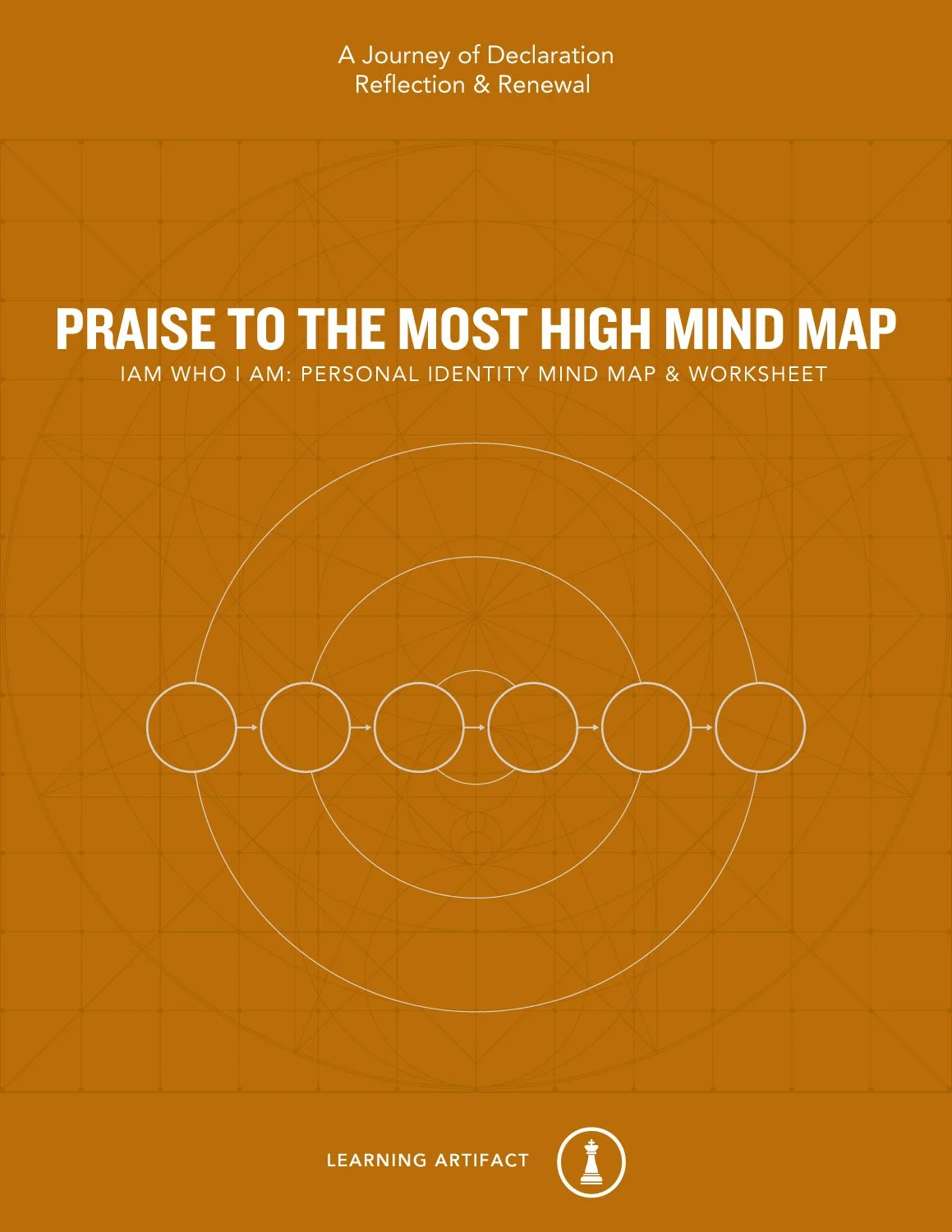
The Praise To The Most High Mind Map is a visual facilitation tool that organizes the 25 reflection questions into six thematic clusters surrounding a central core that bears a triple-ring design — a visual acknowledgment that this is the final session, the closing circle, the place where the journey completes itself. It is not a map to be rushed through. It is a map to be honored — navigated with the care and intentionality that the closing of a significant journey deserves.
Who This Is For
For participants: Anyone who has walked through this entire series and needs a place to land — a closing that honors the weight of what has been discovered and sends them forward with clarity, conviction, and the specific, personal, irreplaceable truth of who they are. Anyone who has been on a long interior journey — through loss, through rebuilding, through the slow process of recovering a self that was buried under years of fear, performance, or pain — and is ready to close one chapter and begin the next from a completely different foundation. Anyone who wants to end this journey not with a feeling that will fade but with a declaration that will hold.
For facilitators: Spiritual directors, pastoral leaders, counselors, coaches, retreat facilitators, group therapists, educators, and community leaders who have guided a group through the I Am Who I Am series and need a closing session that honors the full weight of the journey — that brings everything together, sends the group forward with intention, and creates a moment of collective declaration that the group will carry long after the final session ends. This resource gives the facilitator the structure, the language, and the navigational tools to close with the same depth and intentionality with which the series began.
For groups: Any group that has journeyed through the I Am Who I Am series together — small groups, women's circles, men's groups, recovery communities, leadership cohorts, faith communities, counseling groups, youth programs, university organizations, or any gathering of people who have chosen to do the honest, vulnerable, transformative work of self-discovery in community — and who deserve a closing that is worthy of everything they have walked through together.
Format: PDF
Page Count: 4 (Not including Cover)
Group Activity Guide
What This Is
Most people spend the majority of their lives managing what is on the outside — their reputation, their relationships, their responsibilities, their results. They become extraordinarily skilled at presenting, performing, and producing. And they become quietly, sometimes desperately, unfamiliar with what is happening on the inside.
This resource is an invitation to go inward.
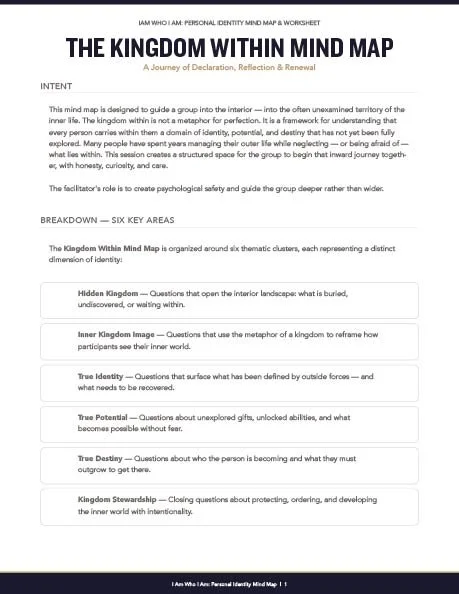
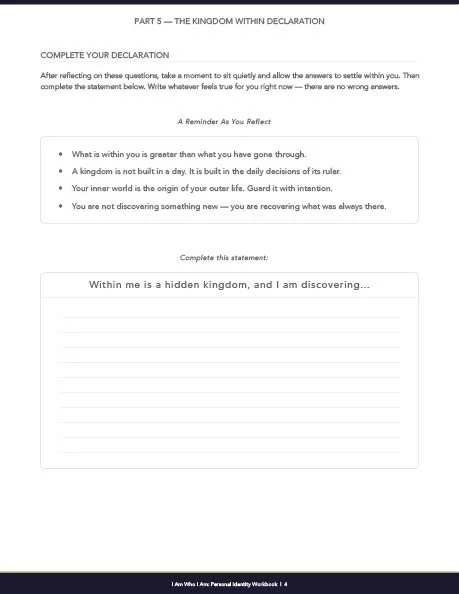
Part 5 of the I Am Who I Am series is a group facilitation experience built around one of the most profound and least explored ideas in personal development: that within every person is an interior world — a kingdom — that contains their true identity, their true potential, and their true destiny. Not a future version of themselves they have yet to become. Not a possibility contingent on circumstances finally aligning. But a living reality already present within them, waiting not to be created but to be discovered.
The work of this session is not inspiration. It is excavation. It is the careful, honest, sometimes uncomfortable process of going beneath the surface of a life — beneath the noise, the performance, the protection, and the pain — to find what has always been there.
The Part 5 bundle includes a Mind Map for group facilitation and a Reflection Worksheet for personal written exploration. Together they form a complete guided experience — one that moves a group from the familiar territory of outer life management into the often uncharted and deeply rewarding territory of inner life discovery.
The Mind Map — Group Facilitation Tool
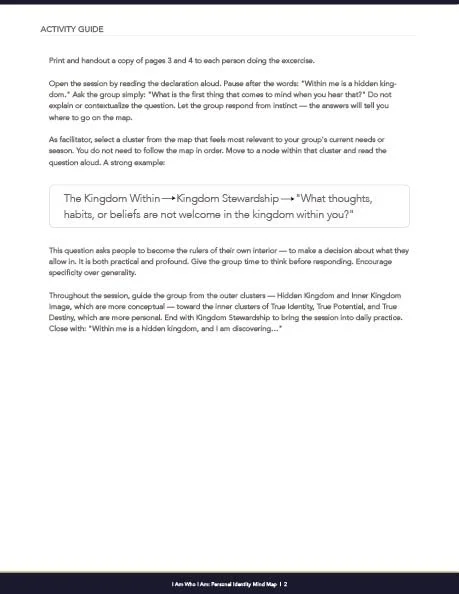
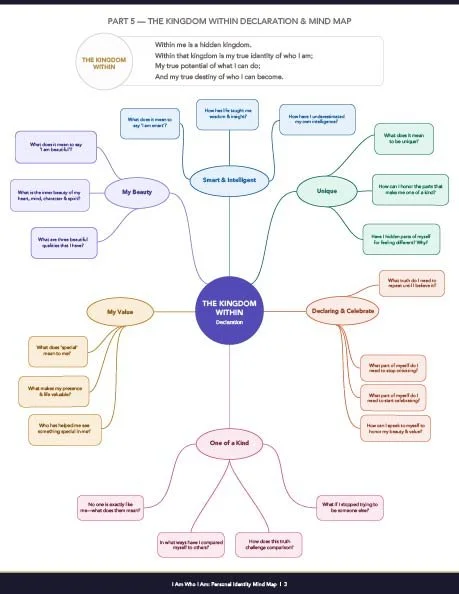
The Kingdom Within Mind Map is a visual facilitation tool that organizes the 25 reflection questions into six thematic clusters arranged around a central core. Unlike a linear curriculum, this map is designed to be navigated in response to the group — entering from wherever the conversation is most alive, pressing deeper when the group is ready, and allowing the natural interior arc of the session to move from the conceptual toward the deeply personal.
Who This Is For
For participants: Anyone who has spent years managing the outside of their life while feeling increasingly unfamiliar with the inside. Anyone who has survived something significant and is still trying to understand what it did to them — and what it did not destroy. Anyone who has a persistent, quiet sense that there is more within them than what has been expressed, developed, or believed — and who is finally ready to go looking for it. Anyone who has asked the question Is this all I am? — and suspected, even hoped, that the answer is no.
For facilitators: Therapists, counselors, life coaches, spiritual directors, pastoral leaders, retreat facilitators, organizational development consultants, educators, and mentors working with individuals or groups who are navigating identity questions, personal transformation, spiritual growth, or the long, nonlinear process of becoming who they were always meant to be. This resource provides a structured, repeatable framework for guiding groups into interior territory with safety, intentionality, and depth.
For groups: Healing and recovery communities, spiritual formation groups, leadership development cohorts, women's empowerment circles, men's growth groups, young adult programs, university student organizations, grief and transition support groups, faith communities, and any gathering of people who are willing to move beyond the surface of their lives — and who are ready to discover together what has been hidden within each of them all along.
Format: PDF
Page Count: 4 (Not including Cover)
Group Activity Guide
What This Is
There is a version of service that looks generous on the outside but is quietly destroying the person giving it. It is the service that comes from the need to prove worth. The helping that never stops because stopping feels like failure. The giving that has no source behind it — no well to draw from, no place to return to, no foundation beneath the output. It looks like devotion. It feels like depletion.
This resource exists to examine that pattern honestly — and to offer something different.
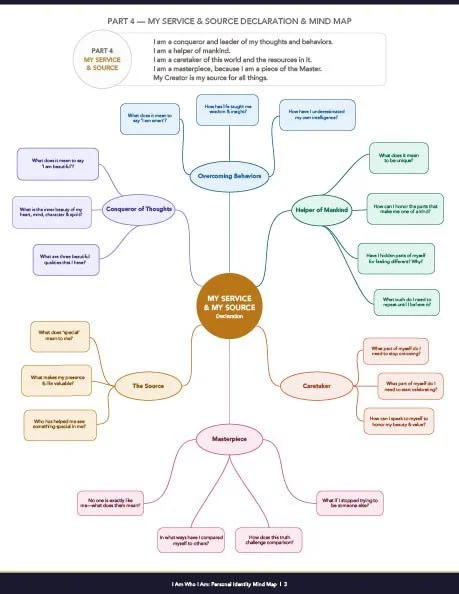
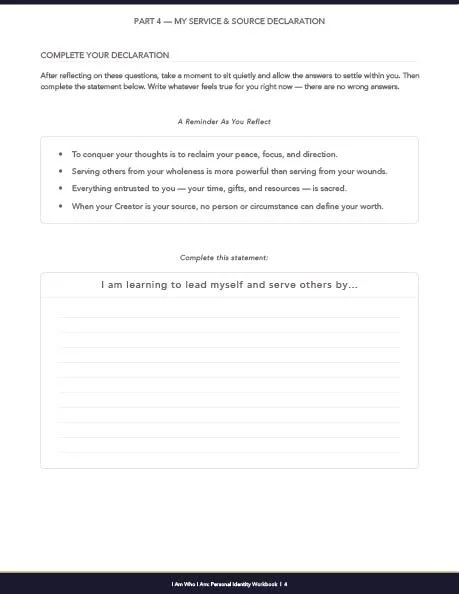
Part 4 of the I Am Who I Am series is a group facilitation experience that moves through four interconnected dimensions of a life lived with purpose: self-leadership, service, stewardship, and source. It does not begin with what you do for others. It begins with how you lead yourself — because a person who cannot govern their own thoughts, habits, and behaviors will eventually serve others from a place of emptiness, prove their worth through exhaustion, and mistake activity for purpose.
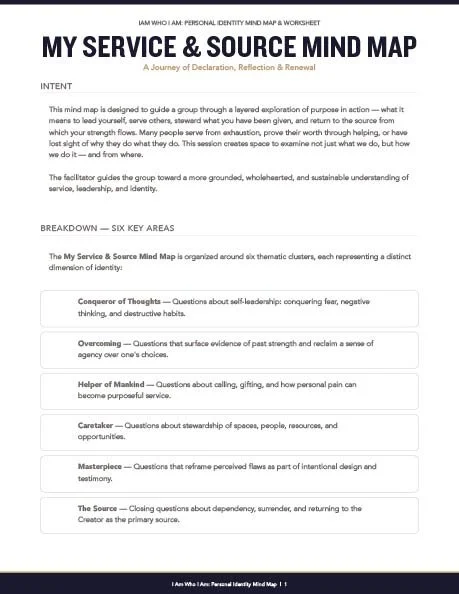
The Part 4 bundle includes a Mind Map for group facilitation and a Reflection Worksheet for personal written exploration. Together they form a complete guided experience — one that moves a group from the question of what do I do into the far more important questions of how do I lead myself, why do I serve, what have I been entrusted with, and where am I drawing my strength from.
The Mind Map — Group Facilitation Tool
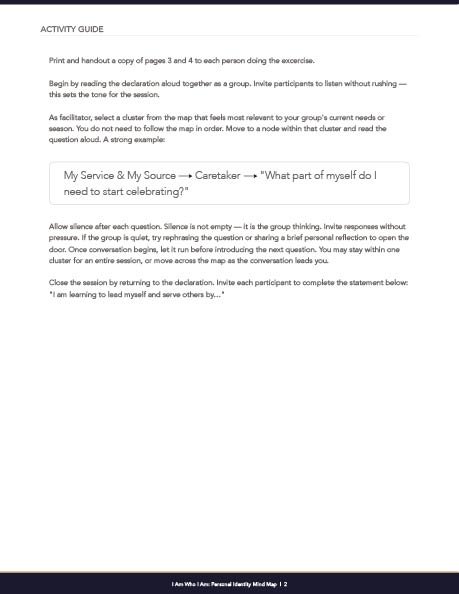
The My Service & My Source Mind Map is a visual facilitation tool that organizes the 25 reflection questions into six thematic clusters. It is not a curriculum to be delivered in sequence. It is a map to be navigated — the facilitator moving through it in response to what the group surfaces, pressing into the areas where the conversation goes quiet, and following the energy where it is most alive.
Who This Is For
For participants: Anyone who has been serving from exhaustion rather than overflow. Anyone who has built their identity around what they do for others and lost sight of who they are apart from it. Anyone who has been trying to lead others — a family, a team, a community, a congregation — while privately struggling to lead themselves. Anyone who has been drawing from sources that are running dry and is ready to examine honestly what they have been depending on, and what a more sustaining foundation might look like.
For facilitators: Counselors, life coaches, ministry leaders, nonprofit directors, human resource professionals, organizational development consultants, therapists, educators, and community leaders working with people in helping professions, leadership roles, or seasons of burnout and transition. This resource provides a structured framework for guiding groups into honest conversation about the internal cost of service, the foundations of sustainable giving, and the relationship between self-leadership and purposeful contribution.
For groups: Nonprofit teams, ministry staff, healthcare workers, educators, social workers, community organizers, leadership cohorts, pastoral teams, caregiver support groups, entrepreneurship communities, and any group of people who give significantly of themselves — and who need a structured space to examine honestly whether they are giving from a place of wholeness or depletion, calling or compulsion, source or survival.
Format: PDF
Page Count: 4 (Not including Cover)
Group Activity Guide
What This Is
Potential is one of the most spoken and least believed words in the human experience. People hear it from teachers, coaches, parents, and mentors. They nod when it is said about them. And then they quietly return to the life they have already decided is the limit of what they are capable of.
This resource exists to interrupt that pattern.
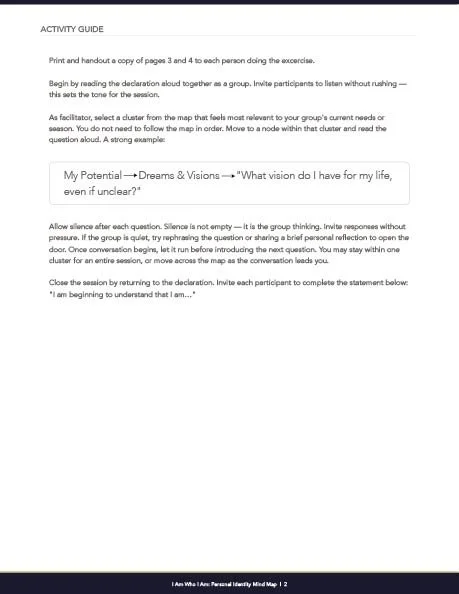
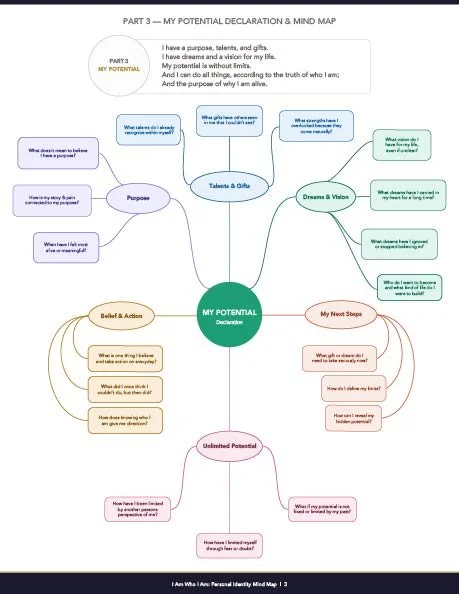
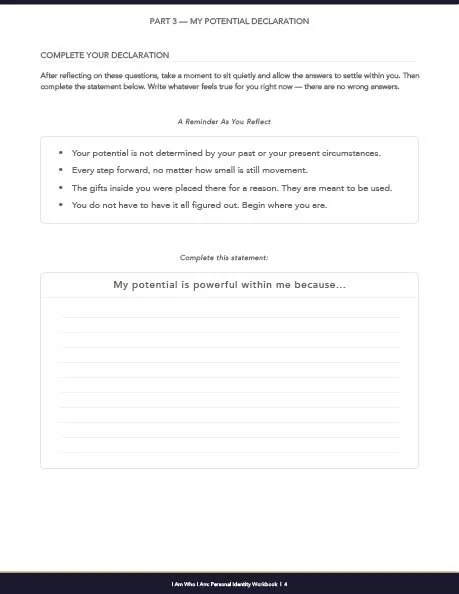
Part 3 of the I Am Who I Am series is a group facilitation experience centered on excavation — not motivation. The goal is not to inspire people with possibility and send them home feeling temporarily energized. The goal is to help a group locate exactly where their potential has been buried, what buried it, and what it would take to begin recovering it. That is slower, more honest, and far more lasting work than inspiration alone.
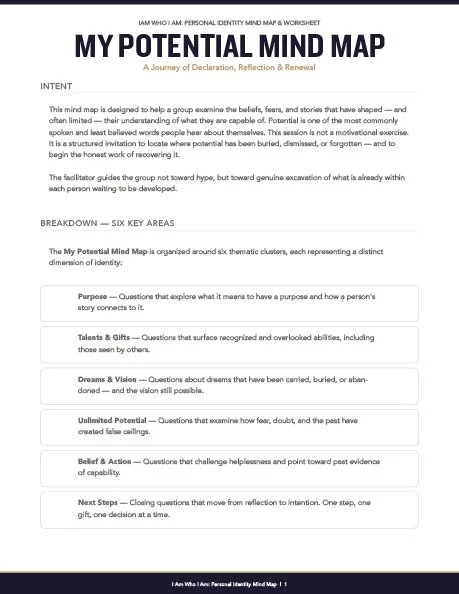
The Part 3 bundle includes a Mind Map for group facilitation and a Reflection Worksheet for personal written exploration. Together they form a complete guided experience — moving a group from the surface question of what can I do into the deeper questions of what have I stopped believing I can do, and why.
The Mind Map — Group Facilitation Tool
The My Potential Mind Map is a visual facilitation tool that organizes the 24 reflection questions into six thematic clusters. It is a navigational instrument designed to be moved through in response to the group, following the conversation where it leads and pressing into the areas where the resistance is greatest.
Who This Is For
For participants: Anyone who has been living beneath their own capacity for so long that it has started to feel normal. Anyone who has a dream they have not spoken aloud in years because hope has become too risky. Anyone who has been told they have potential by others but has never quite been able to take up residence in that belief themselves. Anyone who is ready — not to be motivated — but to be honest about what has been in the way, and to begin the real work of removing it.
For facilitators: Counselors, life coaches, career coaches, educators, mentors, youth workers, pastors, group therapists, and community leaders who work with people navigating transitions, recovering from setback, or trying to locate direction in a season of uncertainty. This resource provides a structured, repeatable framework for guiding groups into honest conversation about capacity, limitation, and the specific internal barriers that keep potential theoretical rather than lived.
For groups: Career development cohorts, entrepreneurship programs, recovery communities, student organizations, leadership development groups, reentry programs, faith communities, mentorship circles, and any group of people who are willing to be honest with each other about the gap between who they are and who they know they could become — and who are ready to begin closing it.
Format: PDF
Page Count: 4 (Not including Cover)
Group Activity Guide
What This Is
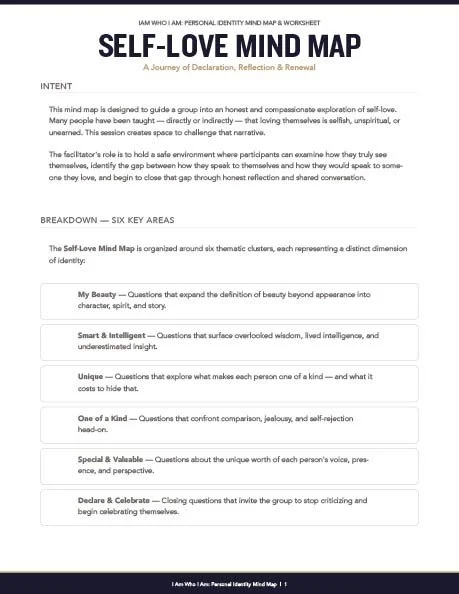
Most people have been taught — directly or indirectly — that loving themselves is something they have to earn. That it is conditional. That it comes after the weight is lost, the mistake is fixed, the approval is won, or the wound is healed. This resource exists to challenge that belief at the root.
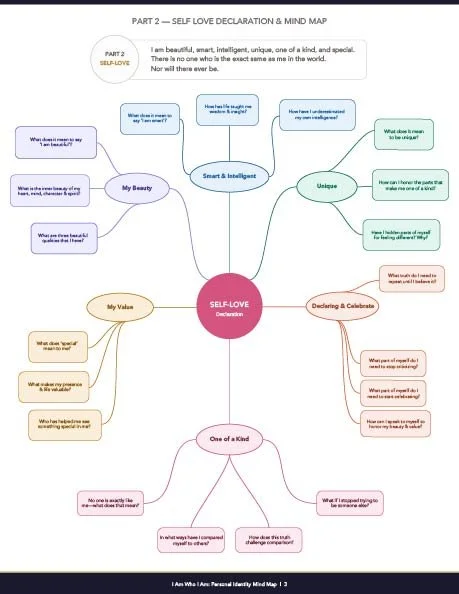
Part 2 of the I Am Who I Am series is a group facilitation experience built around one of the most quietly revolutionary declarations a person can make: I am beautiful, smart, intelligent, unique, one of a kind, and special — and there is no one in the world exactly like me.
The Part 2 bundle includes a Mind Map for group facilitation and a Reflection Worksheet for personal written exploration. Together they create a complete guided experience — one that moves a group from surface-level conversation into honest, transformative dialogue about how they truly see themselves, and what it would take to begin seeing themselves differently.
How to Facilitate
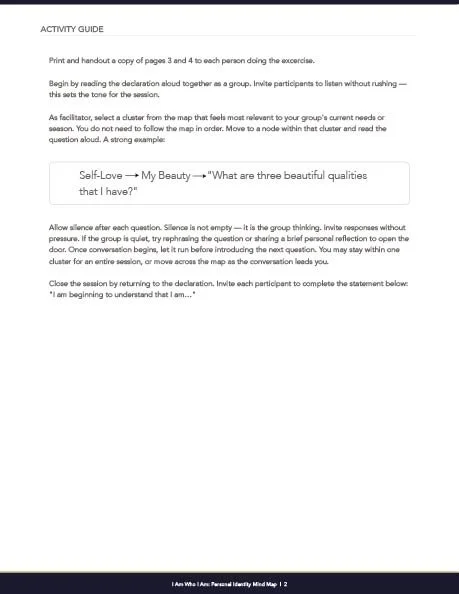
Begin by reading the declaration aloud as a group. Then ask: "Which word in that declaration is hardest for you to say about yourself right now?" Do not move past this question quickly. The answers will tell you exactly where the group is — and where the map needs to take them.
Navigating the Map
Select a cluster based on what surfaces in the opening. You do not need to cover every cluster in a single session. It is far better to go deep into two clusters than to skim across all six. Choose a node within your selected cluster and read the question aloud. A strong example:
Self-Love → One of a Kind → "In what ways have you compared yourself to others instead of appreciating who you are?"
Holding the Space
Self-love is tender territory. Some participants will have spent decades being told — by people they trusted, by institutions they belonged to, by the voice in their own head — that they are not enough. When someone shares something vulnerable in this session, resist the urge to fix it, reframe it too quickly, or move to the next question. Let the group witness each other. That witnessing is itself an act of healing.
Redirecting the Conversation
If the conversation drifts into self-criticism or comparison, gently redirect with curiosity rather than correction: "Where do you think that belief came from?" or "What would it look like to see that part of yourself differently?" These questions create movement without dismissing what was shared.
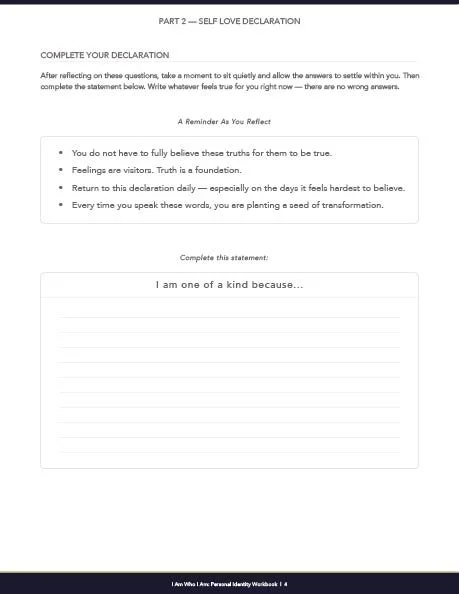
Closing the Session
End by inviting each participant to speak one thing they are choosing to celebrate about themselves — something specific, not general. Then close together with the completion statement:
I am one of a kind because…
Encourage participants to finish that sentence out loud if the group has built enough trust, or in writing if the session calls for more privacy.
Format: PDF
Page Count: 4 (Not including Cover)
Group Activity Guide
What This Is
This is a single-part exploration from the I Am Who I Am series — a focused, standalone tool for anyone ready to examine the most fundamental question a person can ask: Who am I?
The Part 1 bundle includes two complementary resources designed to work together: a Mind Map for group facilitation and guided conversation, and a Reflection Worksheet for personal, in-depth written exploration. Whether you are using both together or one at a time, the experience is the same — a structured, intentional journey into the truth of your identity.
The Mind Map — For Groups & Facilitated Conversation
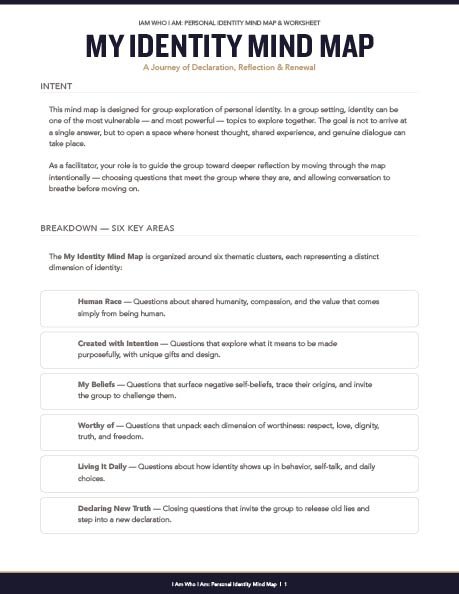
The My Identity Mind Map is a visual facilitation tool designed for group settings — workshops, small groups, classrooms, counseling sessions, team retreats, or any space where intentional conversation about identity can take place.
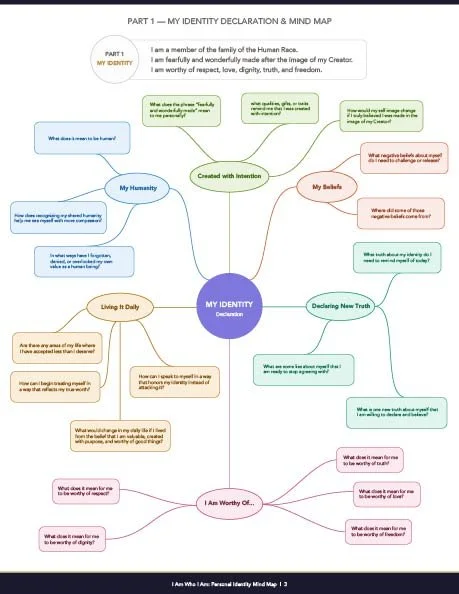
The map organizes 20 reflection questions into six thematic clusters, each representing a distinct dimension of identity:
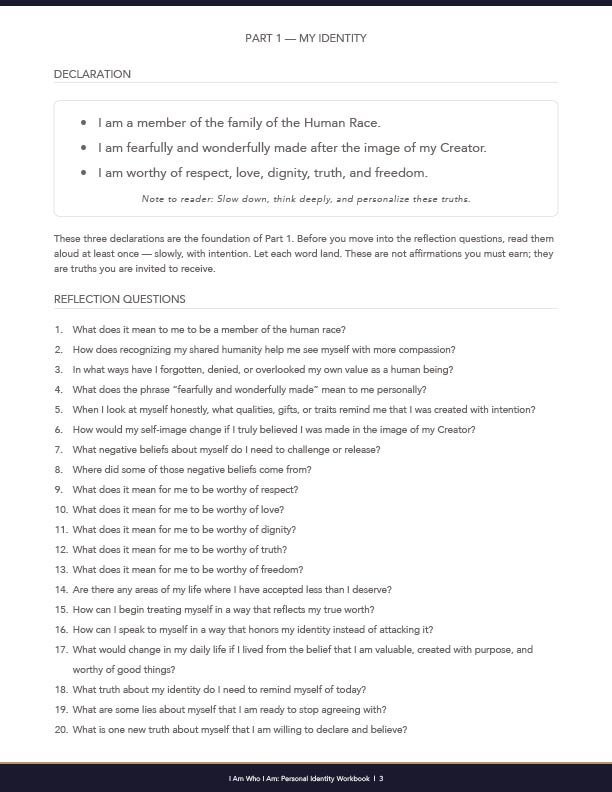
Human Race — What it means to belong to humanity, and how recognizing shared humanity opens the door to self-compassion
Created with Intention — What it means to be fearfully and wonderfully made — and what gifts, qualities, and traits point to purposeful design
Beliefs — The negative beliefs that diminish self-image, where they come from, and how to begin replacing them with truth
Worthy of… — A focused exploration of each dimension of worthiness: respect, love, dignity, truth, and freedom
Living It Daily — How identity shows up — or fails to show up — in daily behavior, self-talk, and personal standards
Declaring New Truth — The closing cluster, where old lies are named and released, and a new truth is chosen and declared
How a Facilitator Uses It
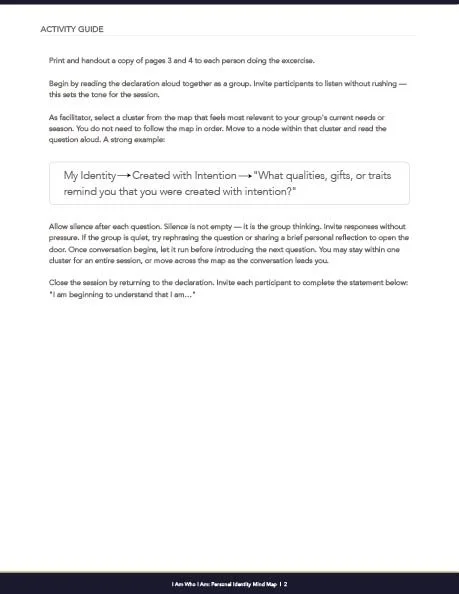
The facilitator selects a cluster that meets the group's current needs, moves to a specific node within that cluster, and presents the question to the group. A strong example:
My Identity → Created with Intention → "What qualities, gifts, or traits remind you that you were created with intention?"
The map is not meant to be followed in order from start to finish. It is a navigation tool — designed to be moved through intuitively, following the conversation where it naturally goes and pressing deeper when the group is ready.
Who This Is For
This resource is for anyone who has ever struggled to answer the question Who am I? with confidence, clarity, or peace.
It is for the person who has spent years being defined by what they have been through — by trauma, by failure, by the labels others placed on them — and is ready to examine whether those definitions are actually true. It is for the facilitator, counselor, coach, pastor, teacher, or group leader who wants a structured, meaningful tool for guiding others into honest self-examination. It is for the individual working quietly and privately through the long process of rebuilding a self-image that has been broken down over time.
It is for anyone who suspects there is more to who they are than what they have been told — or than what they have allowed themselves to believe.
A Note On How To Use It
There is no right pace. Some people will move through all 20 questions in a single sitting. Others will spend an entire week on a single question. Both are correct. The goal is not completion — it is discovery.
Read the declaration aloud before you begin. Return to it when the questions feel heavy. Let the words settle before you move on to the next one. Write freely, without editing yourself. The most honest answers are rarely the ones that come first.
Format: PDF
Page Count: 15
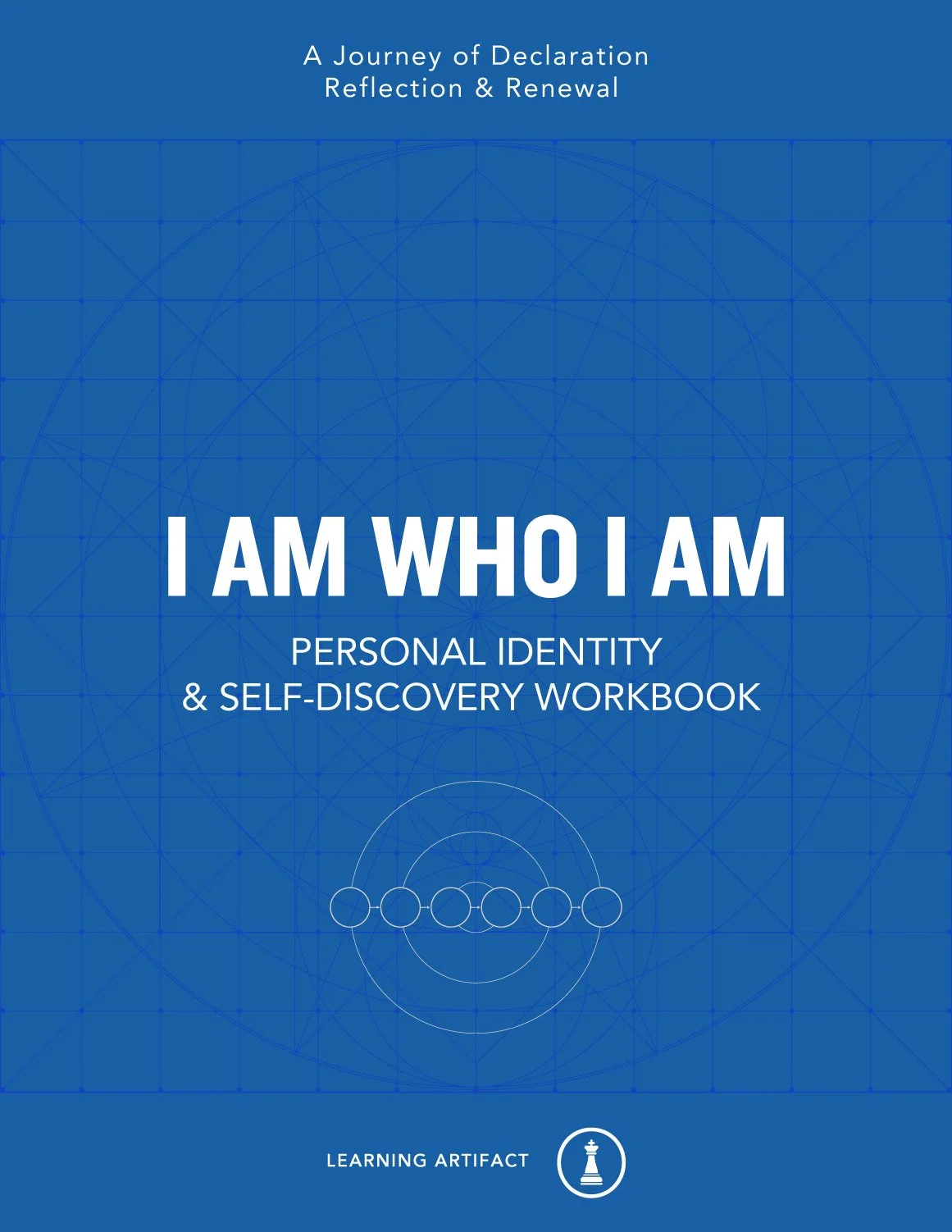
A Journey of Declaration, Reflection & Renewal
What This Workbook Is
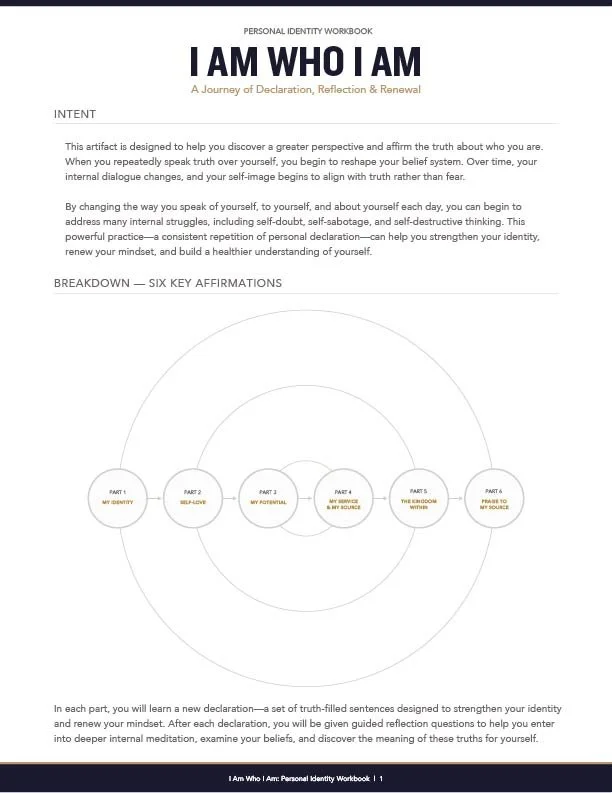
I Am Who I Am is a guided personal identity workbook built around one foundational belief: that the truth of who you are is already within you — waiting to be uncovered, spoken aloud, and lived from the inside out. Through a series of powerful declarations, deep reflection questions, and intentional writing prompts, this workbook will walk you through six transformative explorations of identity, worth, potential, purpose, service, and praise.
It is designed for the person who has been living on the surface of themselves for too long. For the person who has been defined by fear, shaped by the opinions of others, or quietly convinced that they are less than what they actually are. This workbook is an invitation to go deeper — and to discover what has been there all along.
How It Works
Each of the six parts follows the same powerful structure:
Declaration — Every part opens with a set of truth-filled statements spoken directly over your life. These are not affirmations you have to earn or conditions you have to meet. They are truths you are invited to receive. You will be asked to read them aloud, slowly and with intention, allowing each word to land before moving forward.
Reflection Questions — Following each declaration is a carefully crafted series of questions designed to move you beneath the surface. These are not questions with right or wrong answers. They are invitations — to examine your beliefs, revisit your story, challenge your self-image, and discover what you truly think and feel about who you are. Each question is a prompt for deeper thought, honest writing, and genuine self-exploration.
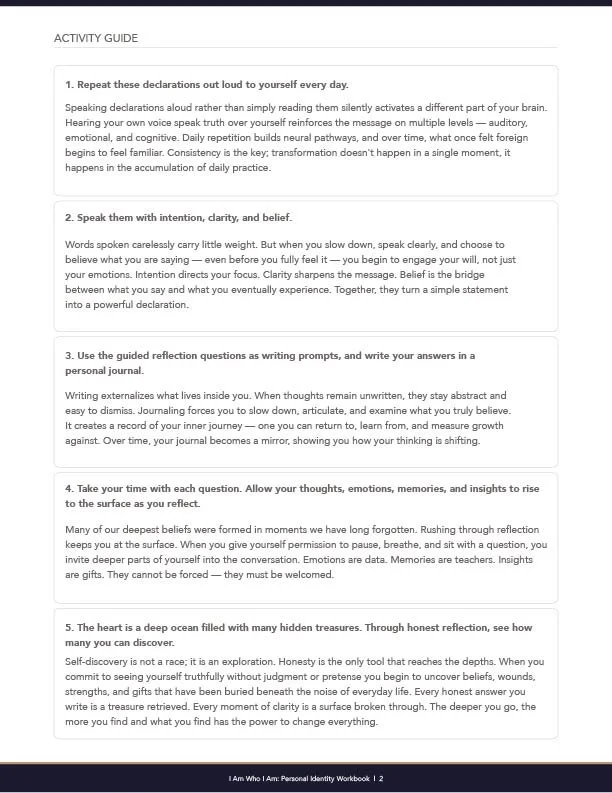
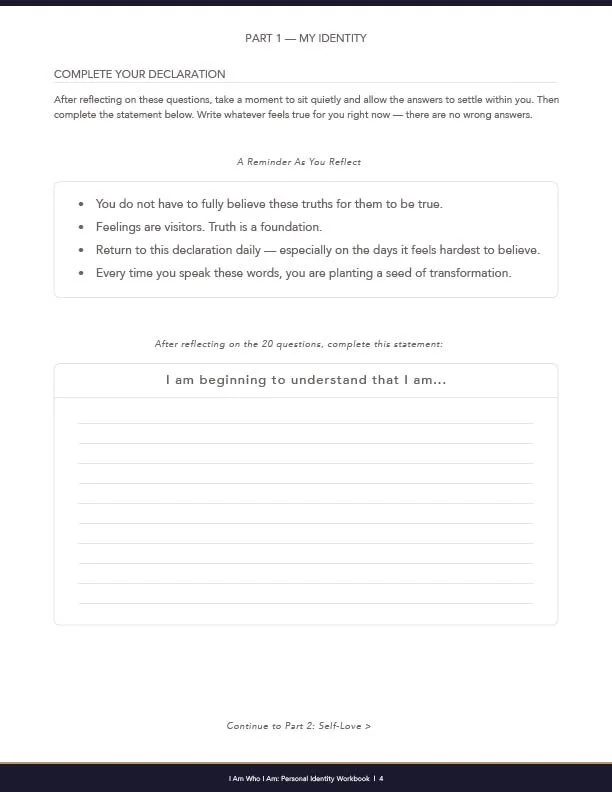
Complete Your Declaration — Every part closes with a guided completion statement. After sitting with the questions, you are invited to write your own words — a personal declaration drawn from what you discovered in the reflection. This is where what you have uncovered becomes something you choose to own.
Who This Workbook Is For
This workbook is for anyone who is ready to stop living from the outside in and start living from the inside out. It is for the person doing the quiet, unglamorous work of rebuilding their self-image after loss, failure, or a long season of being told they were not enough. It is for the person standing at the beginning of something new, who needs a foundation to build from. It is for the person who has everything together on the outside but feels like a stranger to themselves on the inside.
It is for anyone who has ever wondered: Who am I, really? — and is finally ready to find out.
What You Will Need
A pen. A journal. Honesty. And the willingness to take your time.
This workbook is not meant to be rushed. Each part can be explored in a single sitting or spread across several days. The reflection questions are designed to stay with you — to surface thoughts, emotions, and insights throughout your day, not just during the time you spend writing. Give yourself permission to move slowly. The deeper you go, the more you will find.
A Note Before You Begin
The heart is a deep ocean filled with many hidden treasures. Through honest reflection, see how many you can discover.
I am who I am — and so shall I be.
No results match your search. Try removing a few filters.