Worksheets, workbooks, assessments, mind maps, checklists and planners — practical tools to learn and apply every strategy.
Worksheets, workbooks, assessments, mind maps, checklists and planners — practical tools to learn and apply every strategy.
Format: PDF
Page Count: 5 (Not Including Cover)
Reference Guide & Worksheet
What This Is
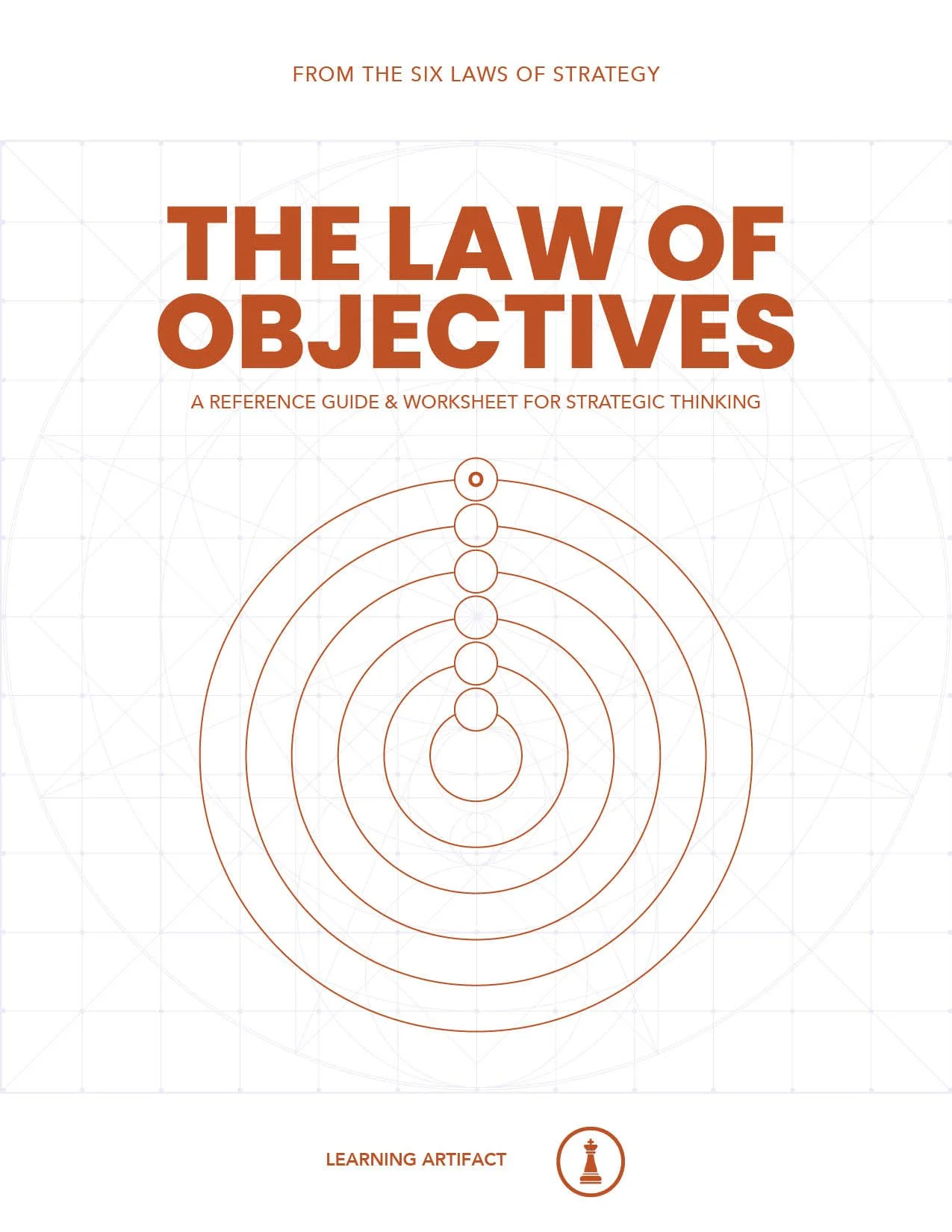
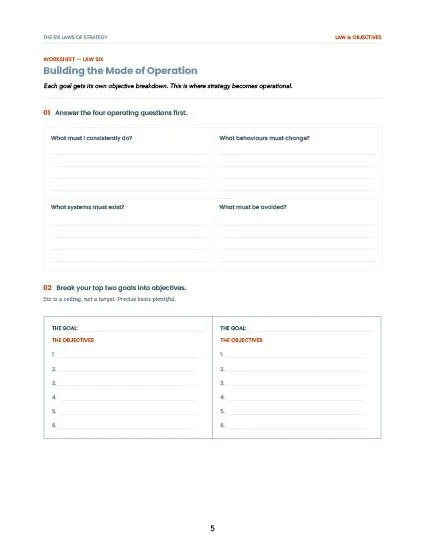
The sixth and final law is where the whole system touches the ground. The problem was identified, the solution chosen, the purpose established, the vision written, the goals set — and none of it moves until somebody decides what will actually be done. This guide and worksheet are where that decision gets made, and written down where you can be held to it.
WHAT'S INSIDE
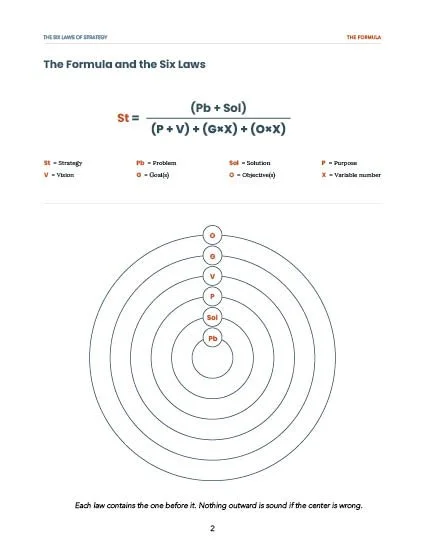
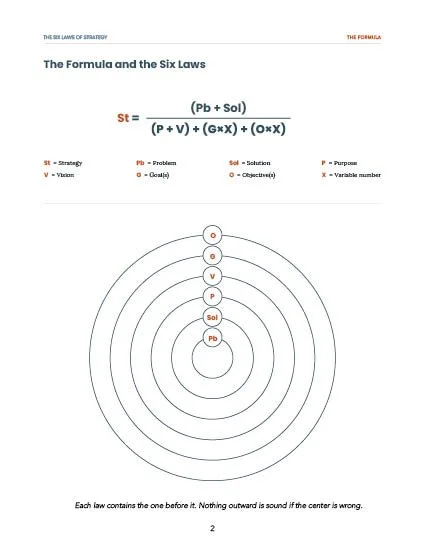
The Formula and the Six Laws (reference page)
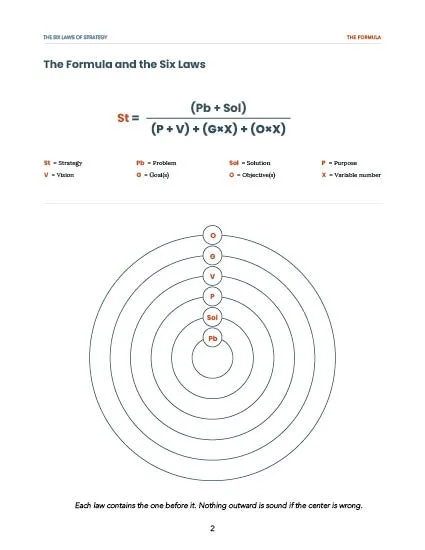
The complete strategy formula with every term defined, plus the concentric ring model showing how the six laws nest inside one another. Each law contains the one before it. Nothing outward is sound if the center is wrong.
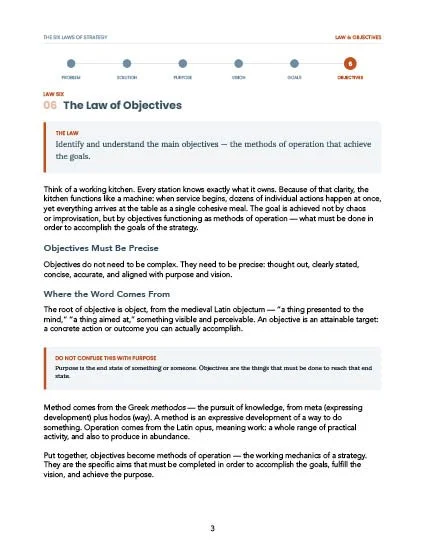
The Law of Objectives (two-page guide)
The law itself
The working kitchen
Objectives must be precise
Where the word comes from
Do not confuse this with purpose
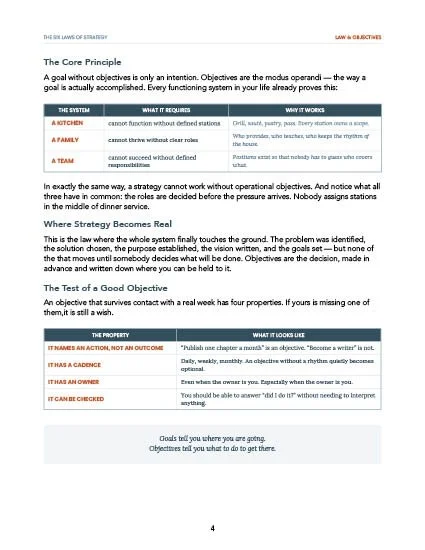
The core principle
The test of a good objective
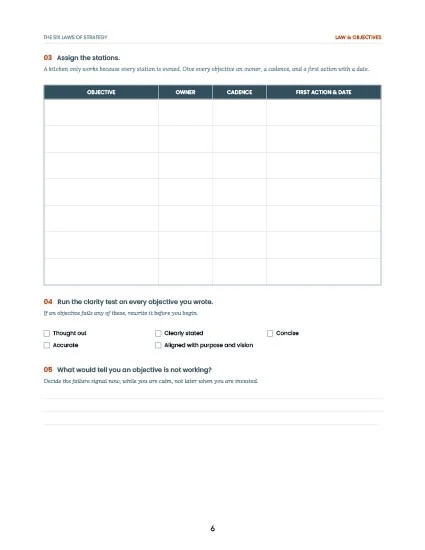
Building the Mode of Operation (two-page worksheet)
FORMAT
8.5in × 11in, US Letter — prints on standard paper
6 pages, print-ready PDF, designed for handwriting
Law Six of the Six Laws of Strategy
WHO IT'S FOR
Anyone whose plan is sound and whose Monday looks identical to last Monday. Especially strong for teams — the stations table turns a shared goal into named ownership, which is usually the thing quietly missing.
HOW TO USE IT
The test on the guide page is the filter: if your objective names an outcome rather than an action, has no rhythm, has no owner, or can't be answered with a plain did I do it, rewrite it before you start. "Become a writer" fails all four. "Publish one chapter a month" passes.
WORKS BEST WITH
The Law of Goals (Law Five), which supplies the goals this worksheet breaks down. Objectives without goals are just a busy list.
Format: PDF
Page Count: 4 (Not Including Cover)
Reference Guide & Worksheet
What This Is
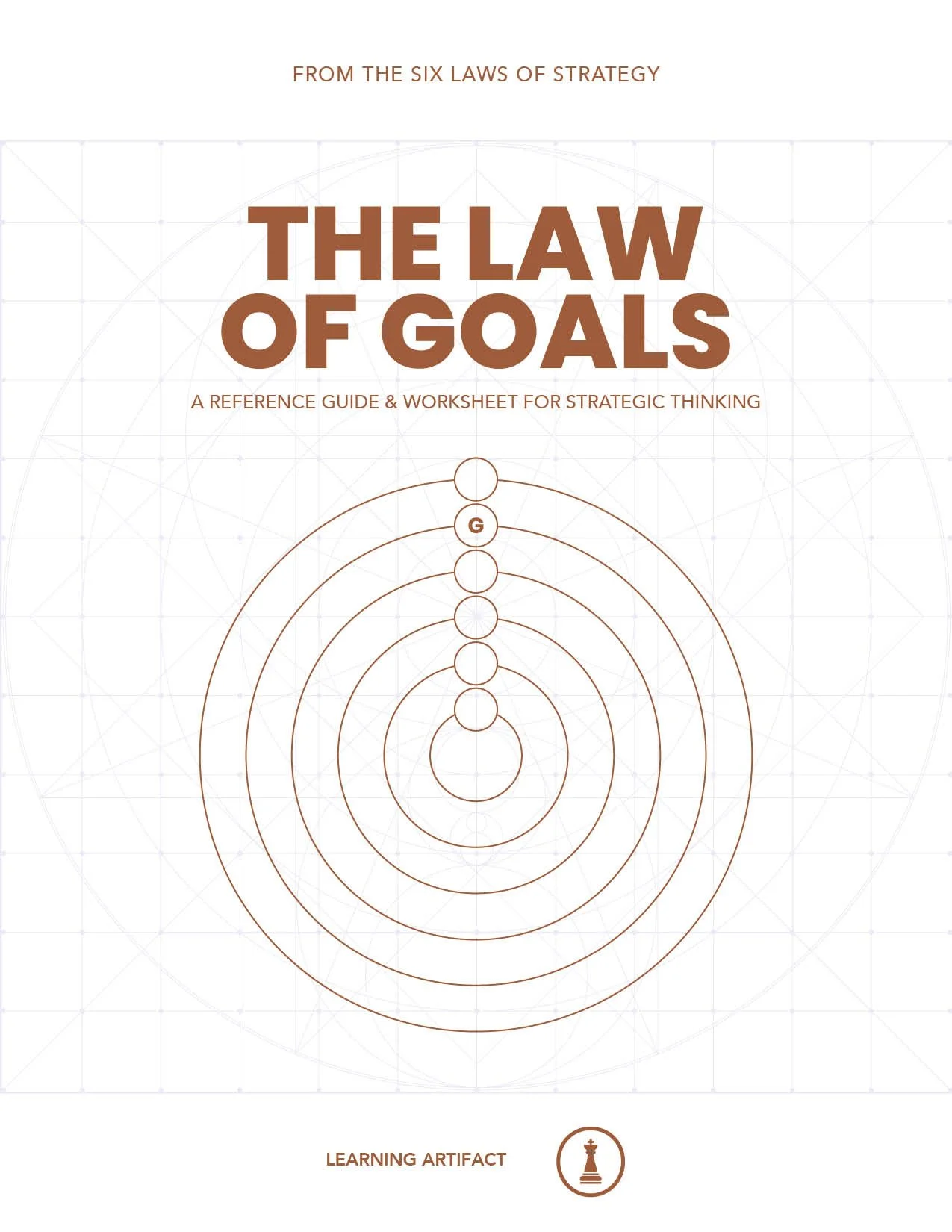
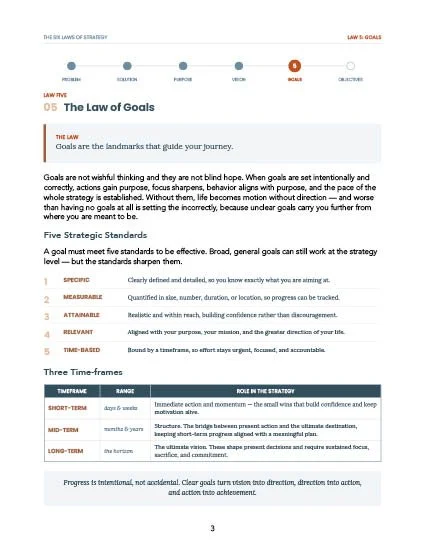
The fifth of the Six Laws is about setting landmarks that actually guide the journey. Five standards every goal has to survive, three timeframes that give a strategy its pace, and a worksheet that tests your goals instead of just recording them.
WHAT'S INSIDE
The Formula and the Six Laws (reference page)
The complete strategy formula with every term defined, plus the concentric ring model showing how the six laws nest inside one another. Each law contains the one before it. Nothing outward is sound if the center is wrong.
The Law of Goals (guide page)
The law itself
Five strategic standards
Three timeframes
The core teaching
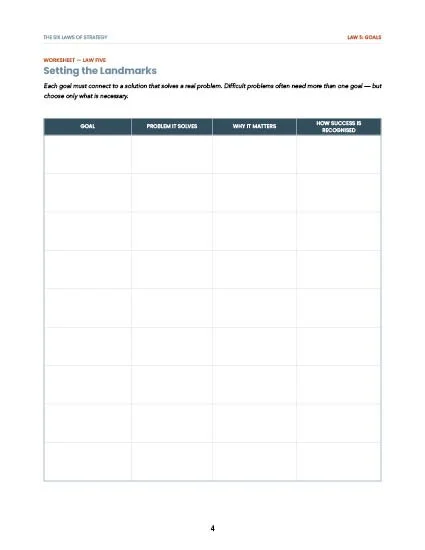
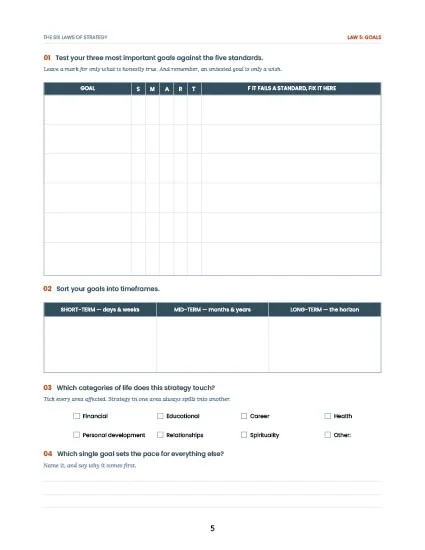
Setting the Landmarks (two-page worksheet)
FORMAT
8.5in × 11in, US Letter — prints on standard paper
5 pages, print-ready PDF, designed for handwriting
Law Five of the Six Laws of Strategy
WHO IT'S FOR
Anyone who sets goals every January and cannot say by March which problem any of them was solving. Also strong for teams and annual planning — the goals table forces every milestone to justify itself against a real problem before it makes the list.
HOW TO USE IT
Question 1 is where this sheet does its real work. Most people have never run a goal through the five standards honestly, and the ones that fail tend to fail on Relevant — they're good goals that belong to somebody else's strategy. Fix them in the right-hand column rather than deleting them.
WORKS BEST WITH
The Law of Vision (Law Four), which supplies the future picture these landmarks are pointing toward, and The Law of Problems, which supplies the problems column.
Format: PDF
Page Count: 5 (Not Including Cover)
Reference Guide & Worksheet
What This Is
The fourth of the Six Laws is about seeing the end from the beginning, then writing it plainly enough that other people can carry it with you. A vision kept private is only a preference.
WHAT'S INSIDE
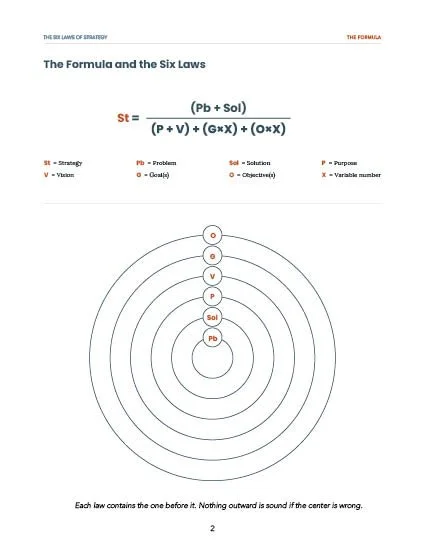
The Formula and the Six Laws (reference page)
The complete strategy formula with every term defined, plus the concentric ring model showing how the six laws nest inside one another. Each law contains the one before it. Nothing outward is sound if the center is wrong.
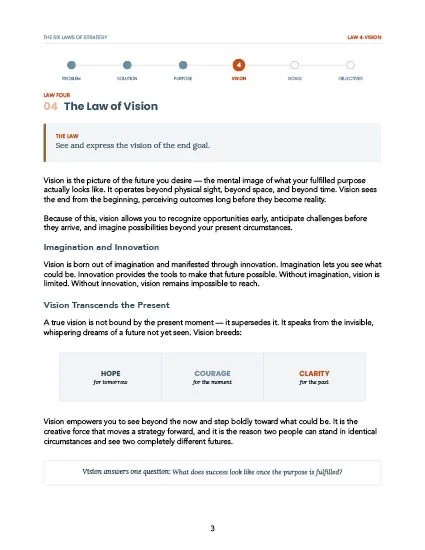
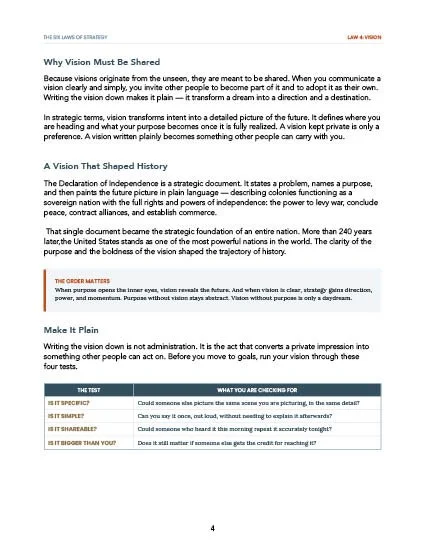
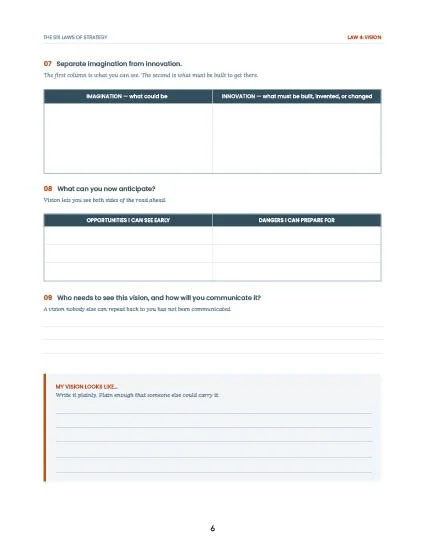
The Law of Vision (two-page guide)
The law itself
Imagination and innovation
What vision breeds
Why vision must be shared
A vision that shaped history
The order matters
Make it plain
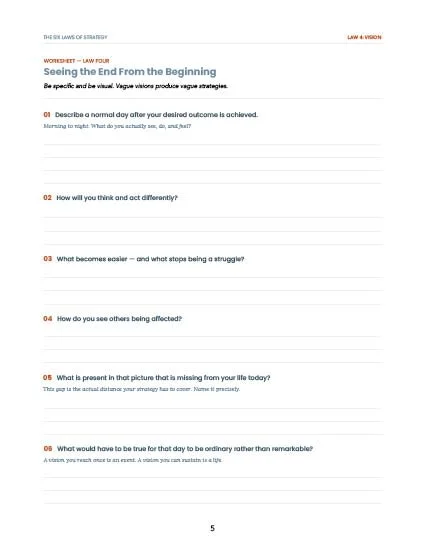
Seeing the End From the Beginning (two-page worksheet)
FORMAT
8.5in × 11in, US Letter — prints on standard paper
6 pages, print-ready PDF, designed for handwriting
Law Four of the Six Laws of Strategy
WHO IT'S FOR
Leaders, founders, ministry and nonprofit teams, and anyone whose team can recite the plan but not the point. Also useful for anyone writing a vision statement who wants something more rigorous than adjectives.
HOW TO USE IT
Question 5 is where this sheet earns its keep. The gap between the picture you just described and your life today is the actual distance your strategy has to cover — and most people have never measured it. Question 6 is the follow-on that separates a vision you reach once from one you can sustain.
WORKS BEST WITH
The Law of Purpose (Law Three), which supplies the purpose this vision is a picture of. Vision without purpose is only a daydream, and this worksheet assumes you've already done that work.
Format: PDF
Page Count: 5 (Not Including Cover)
Reference Guide & Worksheet
What This Is
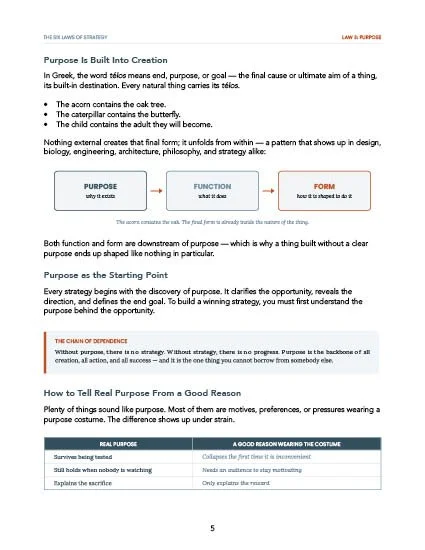
Most people think they have a purpose. What they usually have is a motive wearing a purpose costume, and the difference doesn't show up until something goes wrong. This guide teaches you to tell them apart, then hands you a nine-question worksheet that strips your reasons down to the one that would survive alone.
WHAT'S INSIDE
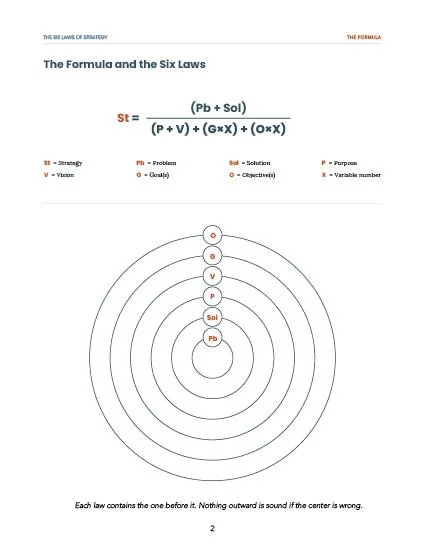
The Formula and the Six Laws (reference page)
The complete strategy formula with every term defined, plus the concentric ring model showing how the six laws nest inside one another. Each law contains the one before it. Nothing outward is sound if the center is wrong.
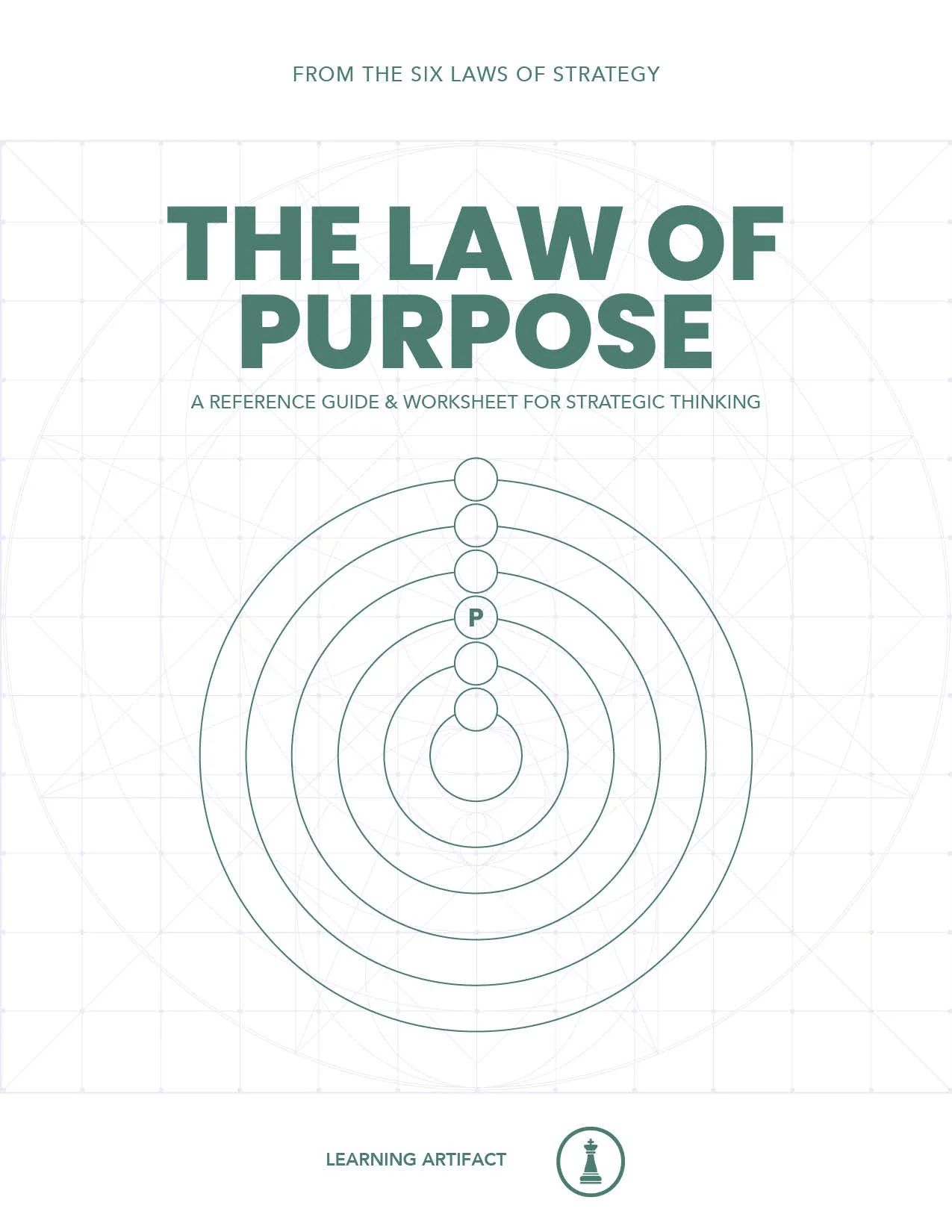
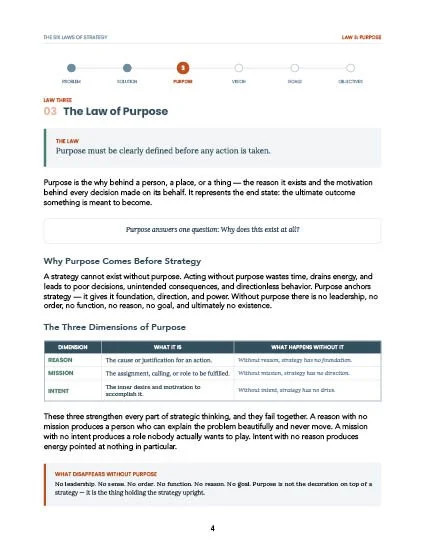
The Law of Purpose (two-page guide)
The law itself
Why purpose comes before strategy
The three dimensions
Purpose is built into creation
Purpose → Function → Form
How to tell real purpose from a good reason
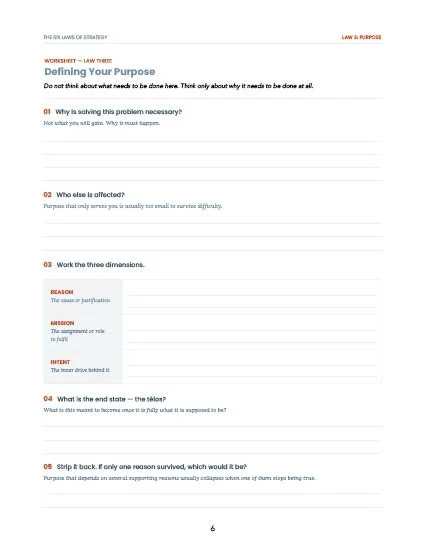
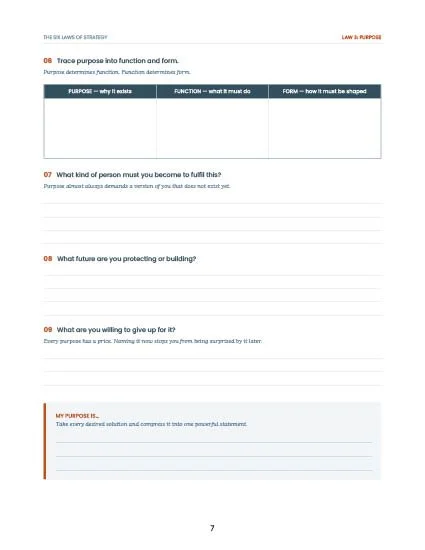
Defining Your Purpose (two-page worksheet)
FORMAT
8.5in × 11in, US Letter — prints on standard paper
6 pages, print-ready PDF, designed for handwriting
Law Three of the Six Laws of Strategy
WHO IT'S FOR
Leaders, founders, ministry and nonprofit teams, and anyone who has been busy and productive for a long stretch without being able to say what it was all for. Also useful for organisations writing or rewriting a mission statement — questions 1 through 5 do most of that work.
HOW TO USE IT
Question 5 is the sharp one, and it's the reason to do this on paper rather than in your head. Most people list four or five reasons and discover that only one of them would hold if the others stopped being true. That one is the purpose. The rest were support beams.
WORKS BEST WITH
The Law of Problems and The Law of Solutions, which supply the root cause and chosen solution this law gives a reason to.
Format: PDF
Page Count: 5 (Not Including Cover)
Reference Guide & Worksheet
What This Is
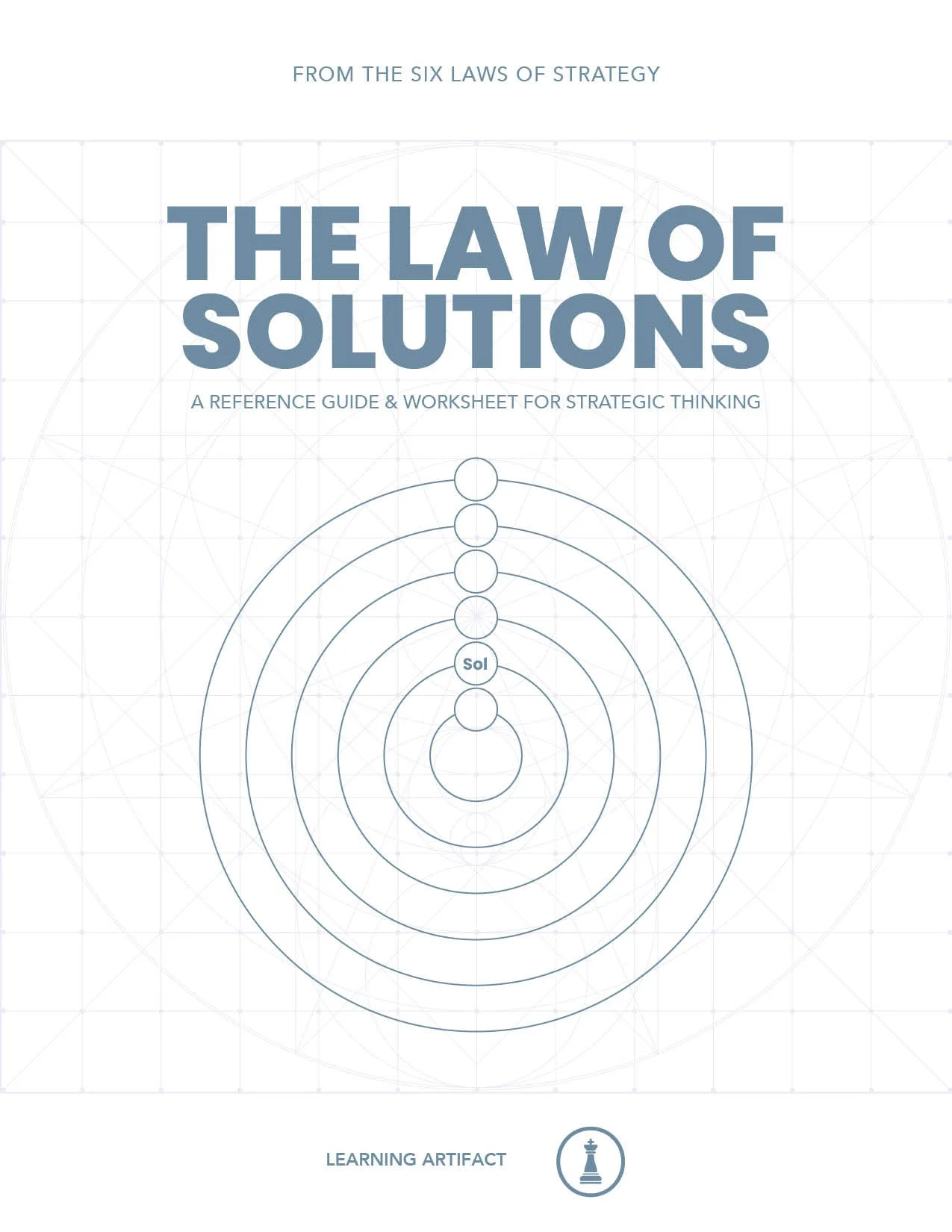
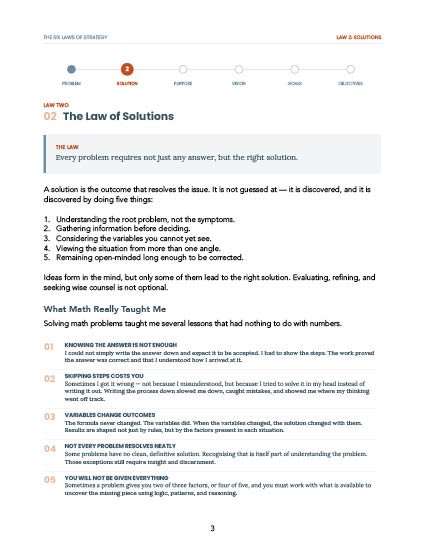
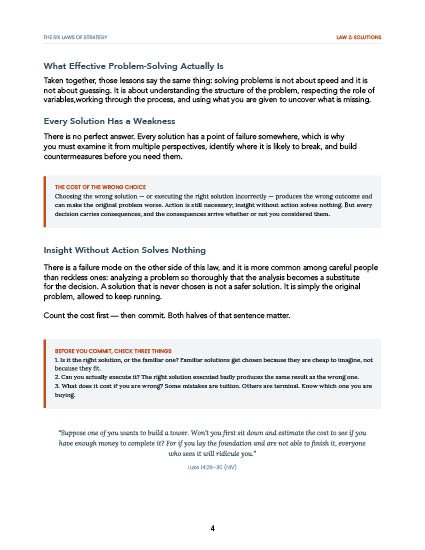
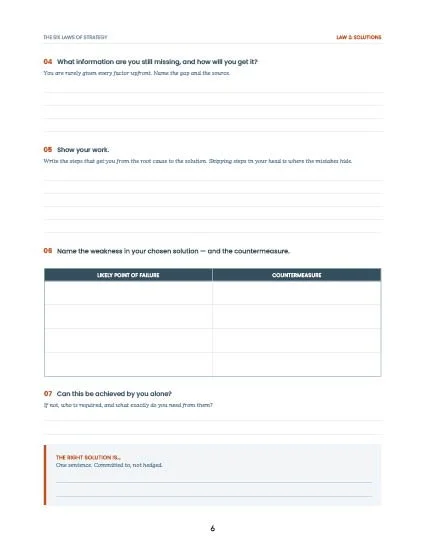
The second of the Six Laws is about discovering the right solution rather than guessing at one. This guide covers how solutions are actually found, why every one of them has a weakness, and the failure mode that catches careful people: analysis becoming a substitute for the decision. Then a two-page worksheet walks a real solution all the way to commitment.
WHAT'S INSIDE
The Formula and the Six Laws (reference page)
The complete strategy formula with every term defined, plus the concentric ring model showing how the six laws nest inside one another. Each law contains the one before it. Nothing outward is sound if the center is wrong.
The Law of Solutions (two-page guide)
The law itself
What math really teaches us
What effective problem-solving actually is
Every solution has a weakness
The cost of the wrong choice
Insight without action solves nothing
Three checks before you commit
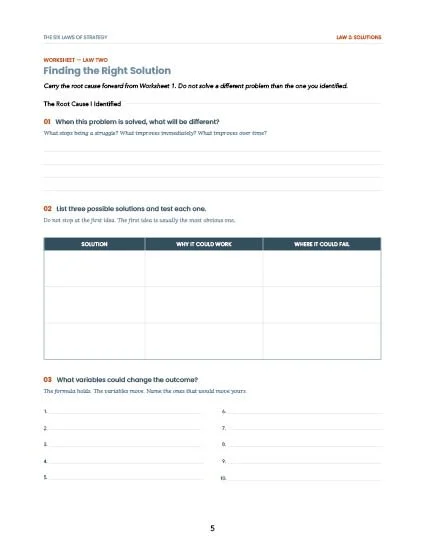
Finding the Right Solution (two-page worksheet)
FORMAT
8.5in × 11in, US Letter — prints on standard paper
5 pages, print-ready PDF, designed for handwriting
Law Two of the Six Laws of Strategy
WHO IT'S FOR
Anyone who keeps choosing solutions that seem sound and then break in month three. Also valuable for teams — the two tables turn "I have a bad feeling about this" into a specific, discussable point of failure.
HOW TO USE IT
This sheet assumes you already have a root cause. Carry it forward from The Law of Problems and write it in the box at the top. Do not solve a different problem than the one you identified — that substitution is the single most common way this law gets broken.
WORKS BEST WITH
The Law of Problems (Law One), which produces the input this worksheet requires, and The Principle of Strategy, Parts 1–3.
Format: PDF
Page Count: 5 (Not Including Cover)
Reference Guide & Worksheet
What This Is
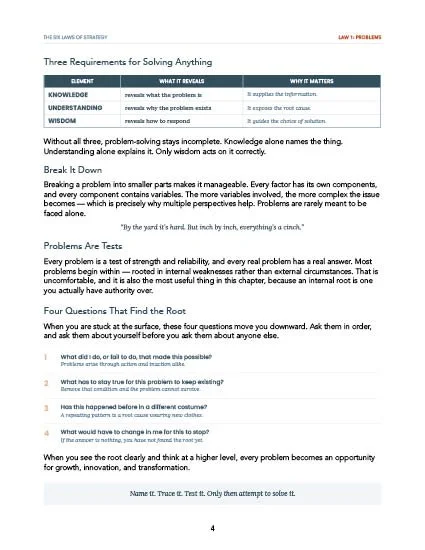
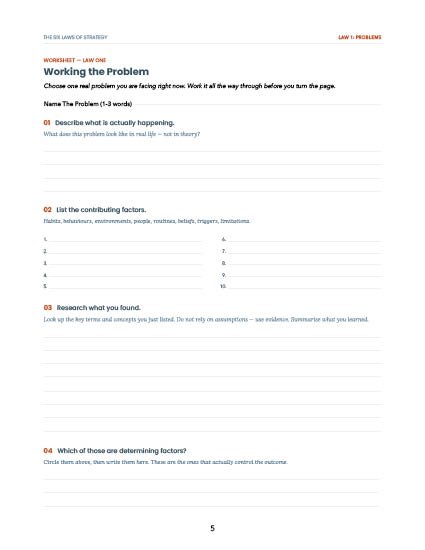
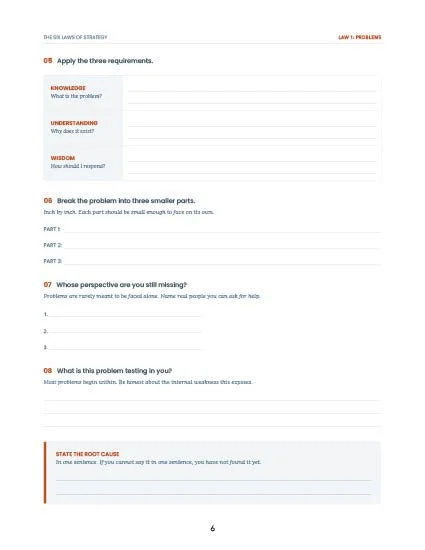
The first of the Six Laws is about seeing clearly before you attempt to fix anything. This guide teaches you to separate surface causes from the one underneath that actually controls the outcome, then gives you a two-page worksheet to run a real problem through — one you're facing right now, not a hypothetical one.
WHAT'S INSIDE
The Formula and the Six Laws (reference page)
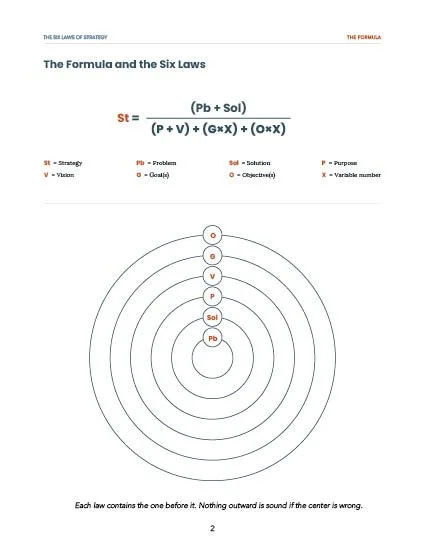
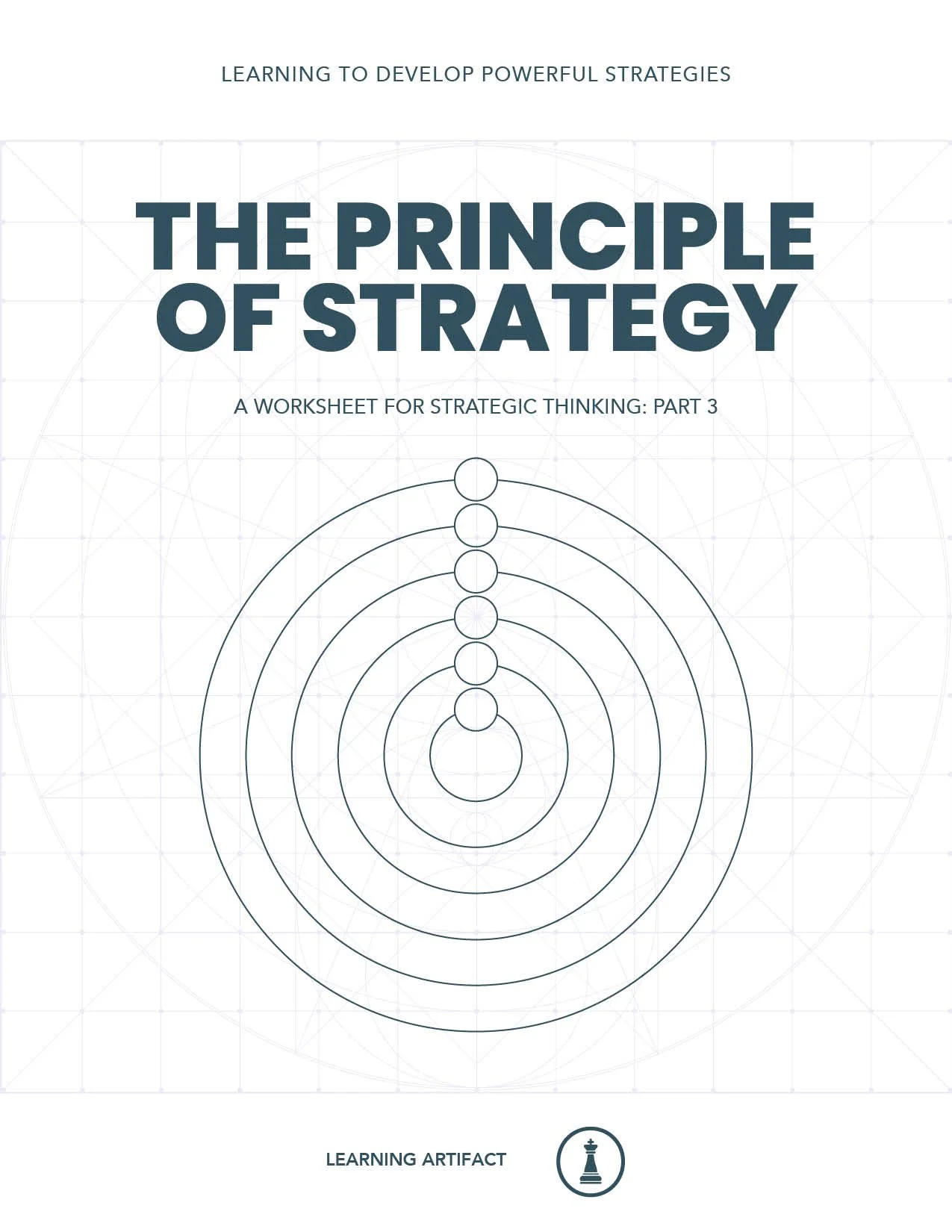
The complete strategy formula with every term defined, plus the concentric ring model showing how the six laws nest inside one another. Each law contains the one before it. Nothing outward is sound if the center is wrong. Keep this page even after you've worked the sheet.
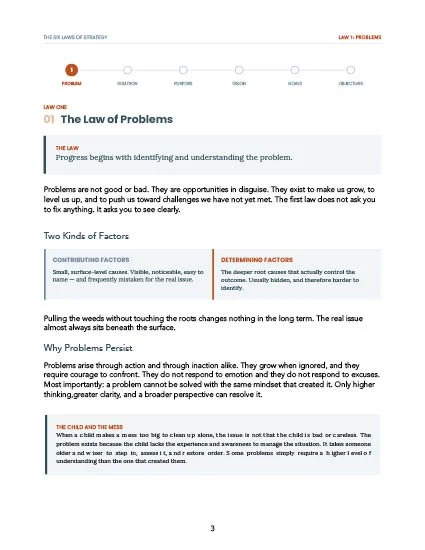
The Law of Problems (two-page guide)
The law itself
Two kinds of factors
Why problems persist
The child and the mess
Three requirements for solving anything
Four questions that find the root
Working the Problem (two-page worksheet)
FORMAT
8.5in × 11in, US Letter — prints on standard paper
5 pages, print-ready PDF, designed for handwriting
Law One of the Six Laws of Strategy
WHO IT'S FOR
Leaders, founders, ministry and nonprofit teams, and anyone who keeps solving the same problem twice. Also strong for team sessions — the contributing-versus-determining distinction gives a group fast, unemotional language for a disagreement about causes.
HOW TO USE IT
Read the guide pages once without a pen. Then pick one real problem — something currently costing you time, money, or peace — and work the sheet all the way through in a single sitting. Allow forty-five minutes. Question 8 is the one most people want to skip, and it's the one that pays.
WORKS BEST WITH
The Principle of Strategy, Parts 1–3, which establish the foundation this law builds on.
Format: PDF
Page Count: 2 (Not Including Cover)
Worksheet
What This Is
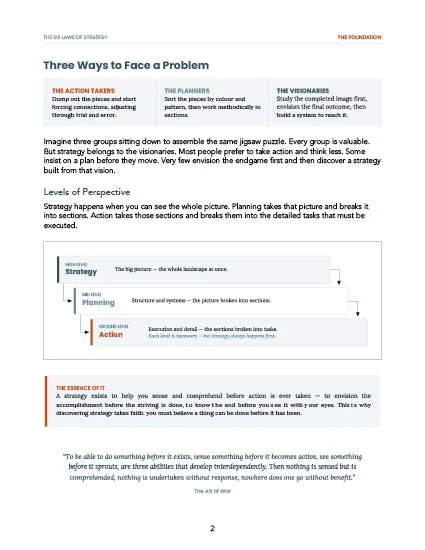
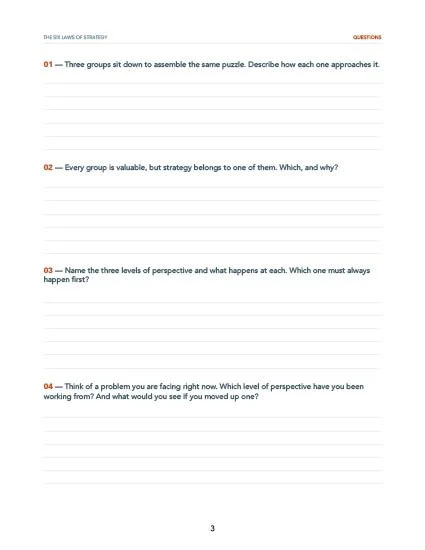
Part 3 is about the difference — and about the altitude problem underneath it. Most people try to solve problems from ground level, where every detail is visible and none of the shape is. One teaching page, four questions, and a final prompt that asks you to identify which level you've been stuck on.
WHAT YOU'LL WORK THROUGH
The teaching page — The Foundation
The jigsaw puzzle
The honest math of it
Levels of Perspective
The essence of it
Closing quote from The Art of War
FORMAT
8.5in × 11in, US Letter — prints on standard paper
Print-ready PDF, designed for handwriting
Part 3 of the Learning to Develop Powerful Strategies series
WHO IT'S FOR
Anyone who is genuinely working hard on a problem and getting nowhere. Usually that isn't an effort problem — it's an altitude problem. Also strong for team sessions: the three puzzle groups give people fast, non-defensive language for how they each default to working.
WORKS BEST WITH
Part 1 (What Strategy Actually Is) and Part 2 (Strategy, Plan, and Action), which establish the definitions this sheet builds on. Part 3 is where the framework starts pointing back at the reader.
Format: PDF
Page Count: 2 (Not Including Cover)
Worksheet
What This Is
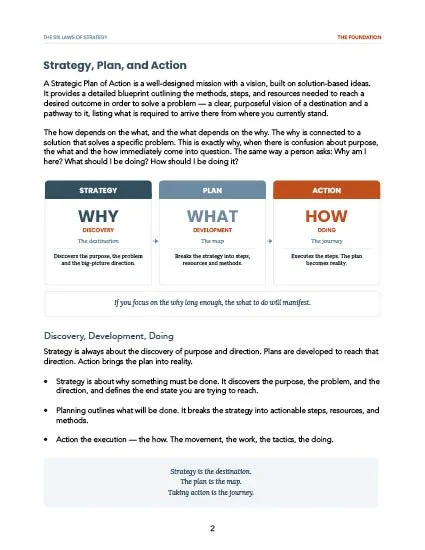
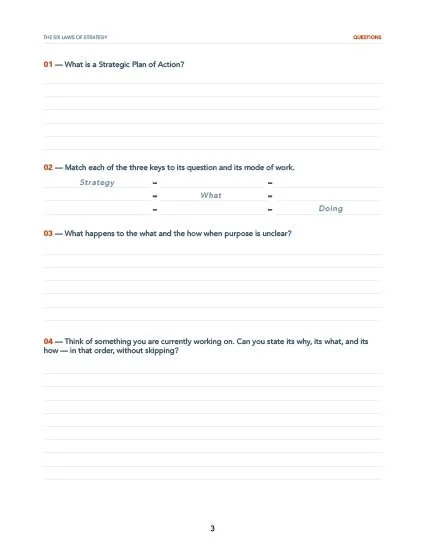
Strategy, plan, and action are three different jobs, and most people collapse them into one. Part 2 sorts out the confusion. One teaching page separating strategy, plan, and action into three distinct jobs, then four questions that check whether the distinction actually landed — including one that turns it on something you're working on right now.
WHAT YOU'LL WORK THROUGH
The teaching page — The Foundation
The Strategic Plan of Action, defined
The dependency chain
The three keys, side by side
Discovery, Development, Doing
FORMAT
8.5in × 11in, US Letter — prints on standard paper
Print-ready PDF, designed for handwriting
Part 2 of the Learning to Develop Powerful Strategies series
WHO IT'S FOR
Leaders, founders, ministry and nonprofit teams, and anyone who keeps busy without moving — the classic symptom of a how running without a why underneath it. Also works well for team sessions, where the matching grid makes a quick shared-language exercise.
WORKS BEST WITH
Part 1, What Strategy Actually Is, which defines the term this sheet builds on. They can be done in either order, but the sequence rewards you.
Format: PDF
Page Count: 2 (Not Including Cover)
Worksheet
What This Is
Most people can use the word strategy fluently and still not be able to define it. That gap is expensive, because everything built on a fuzzy definition inherits the fuzziness. This worksheet closes it.
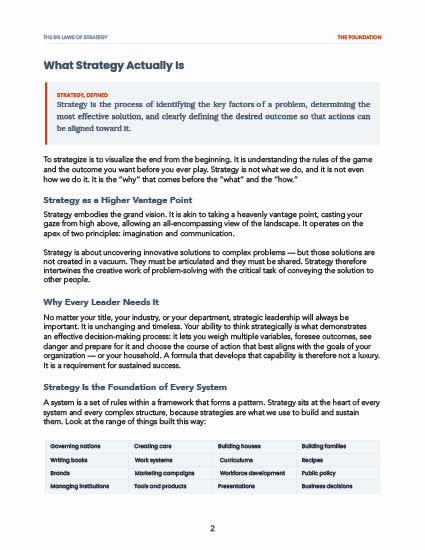
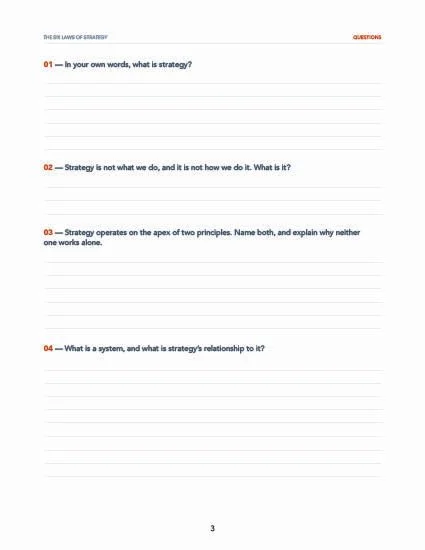
Part 1 covers one idea, thoroughly: what strategy actually is. You read a single focused teaching page, then answer four questions that test whether it stayed with you. No filler, no exercises you'll skip. Twenty minutes, one pen, one clear definition you'll carry into everything after it.
WHAT YOU'LL WORK THROUGH
The teaching page — The Foundation
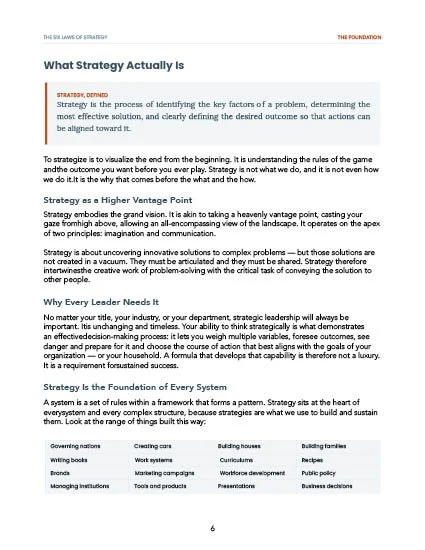
Strategy, defined
Strategy as a higher vantage point
Why every leader needs it
Strategy as the foundation of every system
FORMAT
8.5in × 11in, US Letter — prints on standard paper
Print-ready PDF, designed for handwriting
Part 1 of the Learning to Develop Powerful Strategies series
WHO IT'S FOR
Anyone who leads something — a team, a company, a ministry, a household — and wants the foundation nailed down before building anything on top of it. Also a clean starting point for study groups, onboarding, and classroom use.
HOW TO USE IT
Read the page once without a pen. Read it again slowly. Then cover it and answer the four questions from memory. If you can't answer question 2, go back — the rest of the series depends on it.
Format: PDF
Page Count: 37 (Not Including Cover)
Reference Guide & Workbook
What This is
Most people take action and think less. Some insist on a plan before they move. Very few see the end from the beginning and build a strategy from that vision.
This workbook is for the third group — or for anyone who wants to become part of it.
Strategy is not what you do, and it is not how you do it. It is the why that comes before both. This book breaks that why into six sequential laws, teaches each one, and then hands you a worksheet that makes you apply it to a problem you are actually facing.
WHAT'S INSIDE
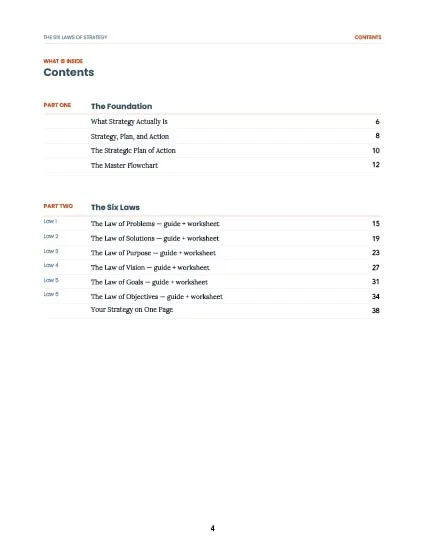
Part One — The Foundation
Before the six laws can be applied, the ground they stand on has to be understood.
What strategy actually is, and why it is unchanging and timeless regardless of your title or industry
Strategy, Plan, and Action — the three keys, the questions each one answers, and why the how always depends on the what, and the what on the why
Three ways to face a problem, and why strategy belongs to the visionaries
The three levels of perspective: high, mid, and ground — and why strategy must always come first
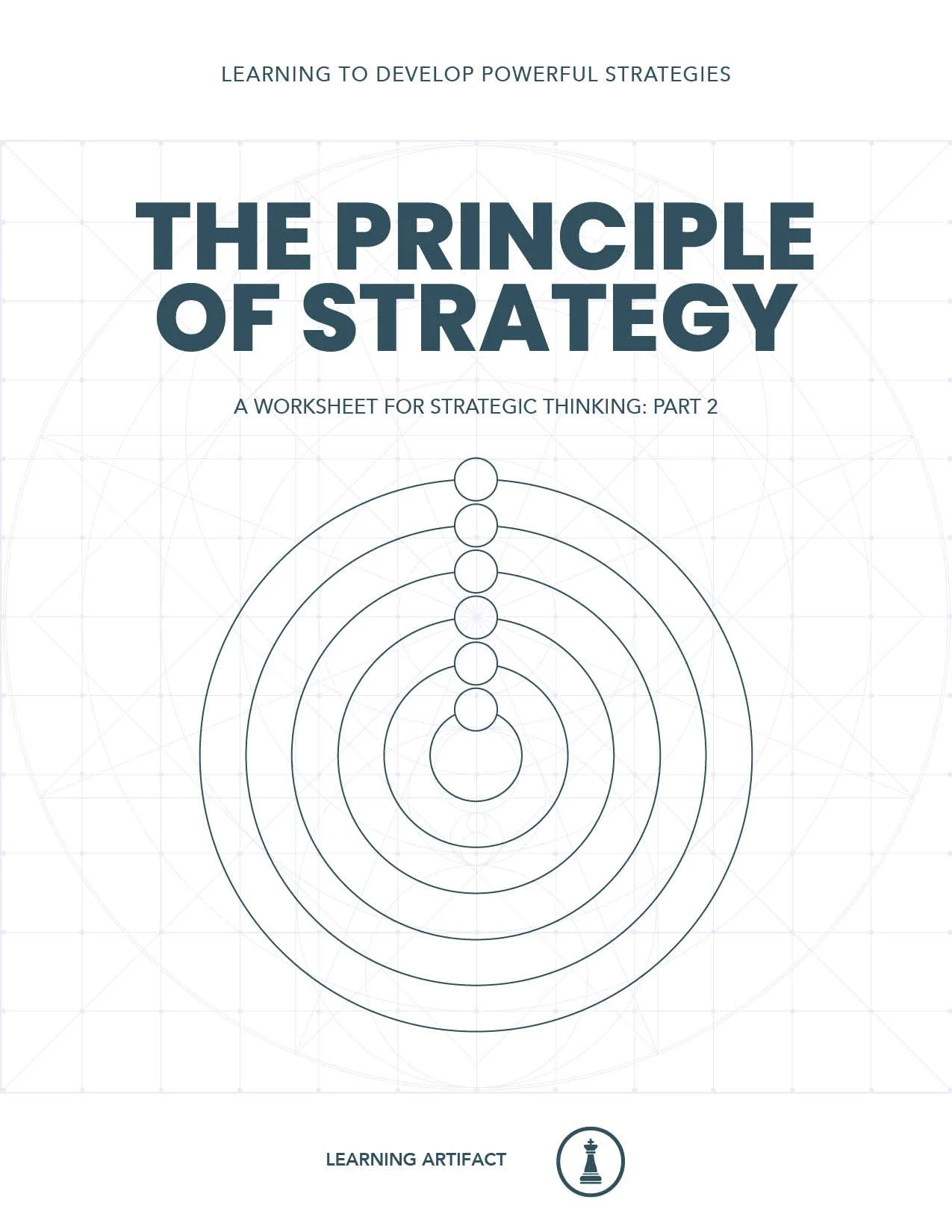
The Master Flowchart — the entire system on a single page, grouped into Discovery, Direction, and Operation
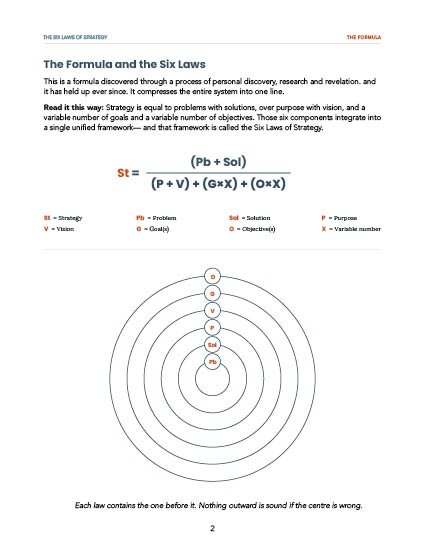
The Concentric Model — the six laws as expanding rings, each one containing the last
Part Two — The Six Laws
Each law gets a teaching section, then a two-page worksheet built from it. A progress indicator shows you exactly where you are in the sequence.
Closing: Your Strategy on One Page — a transfer sheet that compresses all six worksheets into a single working document.
FORMAT
8.5in × 11in, US Letter — prints on standard paper
38 pages, print-ready PDF
Designed for handwriting, with ruled response space, structured tables, and checklists throughout
WHO IT'S FOR
Leaders, founders, ministry and nonprofit teams, parents building a household, and anyone who keeps solving the same problem twice because they never found the root the first time.
No results match your search. Try removing a few filters.