Worksheets, workbooks, assessments, mind maps, checklists and planners — practical tools to learn and apply every strategy.
Worksheets, workbooks, assessments, mind maps, checklists and planners — practical tools to learn and apply every strategy.
Format: PDF
Page Count: 4 (Not including Cover)
Group Activity Guide
What This Is
Every journey needs a place to land.
Not a finish line. Not a graduation. Not a moment where everything is suddenly resolved and the questions stop coming. But a place — a posture, a practice, a declaration — from which a person can look back at everything they have walked through and forward at everything that is still possible, and say with honesty and with weight: I know who I am. I know where I come from. And I am not going back to who I was before I knew.
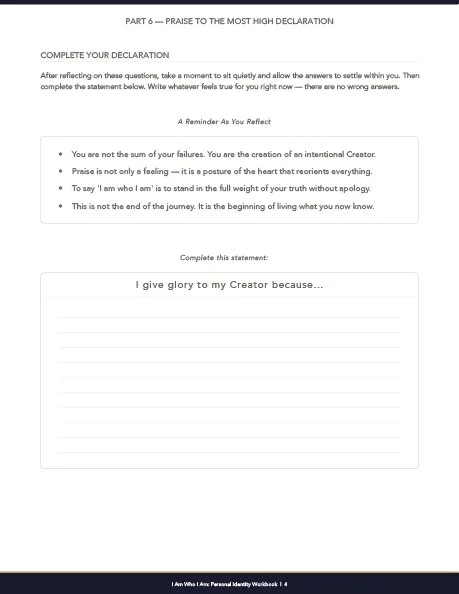
Part 6 of the I Am Who I Am series is that place.
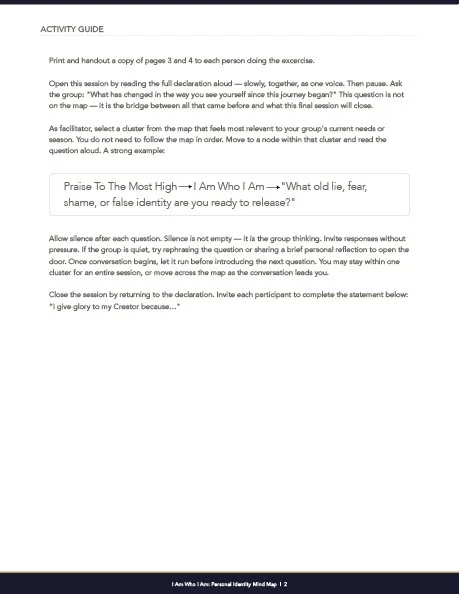
This is the closing session of the journey — a culminating group facilitation experience that draws together everything explored across the previous five parts and anchors it in the most grounding act available to a human being: gratitude, praise, and a final, unqualified declaration of identity. It does not introduce a new framework. It does not add another layer of content. It invites the group to stand fully in what has already been discovered — and to close the journey not with a summary, but with a declaration spoken from the deepest part of who they now understand themselves to be.
The Part 6 bundle includes a Mind Map for group facilitation and a Reflection Worksheet for personal written exploration. Together they form a complete guided closing experience — one that moves a group from the accumulated weight of everything they have examined across this series into the grounded, open-handed, clear-eyed posture of a person who has done the work, faced the truth, and chosen to stand in it.
The Mind Map — Group Facilitation Tool
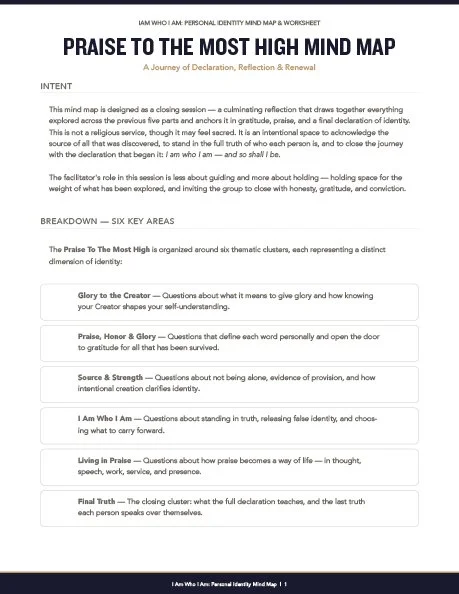
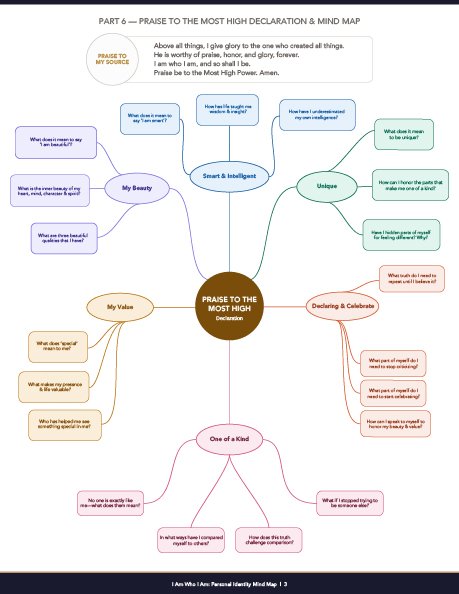
The Praise To The Most High Mind Map is a visual facilitation tool that organizes the 25 reflection questions into six thematic clusters surrounding a central core that bears a triple-ring design — a visual acknowledgment that this is the final session, the closing circle, the place where the journey completes itself. It is not a map to be rushed through. It is a map to be honored — navigated with the care and intentionality that the closing of a significant journey deserves.
Who This Is For
For participants: Anyone who has walked through this entire series and needs a place to land — a closing that honors the weight of what has been discovered and sends them forward with clarity, conviction, and the specific, personal, irreplaceable truth of who they are. Anyone who has been on a long interior journey — through loss, through rebuilding, through the slow process of recovering a self that was buried under years of fear, performance, or pain — and is ready to close one chapter and begin the next from a completely different foundation. Anyone who wants to end this journey not with a feeling that will fade but with a declaration that will hold.
For facilitators: Spiritual directors, pastoral leaders, counselors, coaches, retreat facilitators, group therapists, educators, and community leaders who have guided a group through the I Am Who I Am series and need a closing session that honors the full weight of the journey — that brings everything together, sends the group forward with intention, and creates a moment of collective declaration that the group will carry long after the final session ends. This resource gives the facilitator the structure, the language, and the navigational tools to close with the same depth and intentionality with which the series began.
For groups: Any group that has journeyed through the I Am Who I Am series together — small groups, women's circles, men's groups, recovery communities, leadership cohorts, faith communities, counseling groups, youth programs, university organizations, or any gathering of people who have chosen to do the honest, vulnerable, transformative work of self-discovery in community — and who deserve a closing that is worthy of everything they have walked through together.
Format: PDF
Page Count: 4 (Not including Cover)
Group Activity Guide
What This Is
Most people spend the majority of their lives managing what is on the outside — their reputation, their relationships, their responsibilities, their results. They become extraordinarily skilled at presenting, performing, and producing. And they become quietly, sometimes desperately, unfamiliar with what is happening on the inside.
This resource is an invitation to go inward.
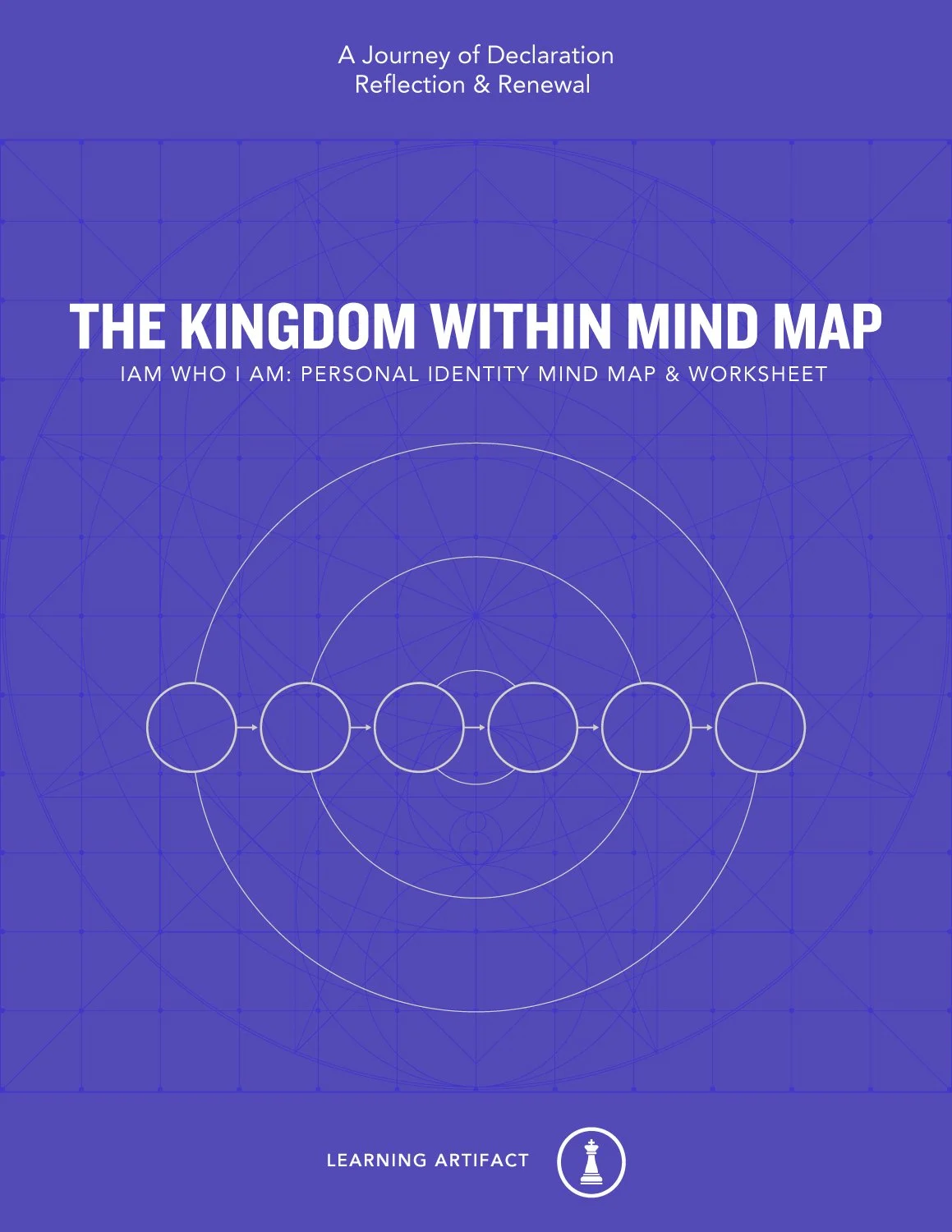
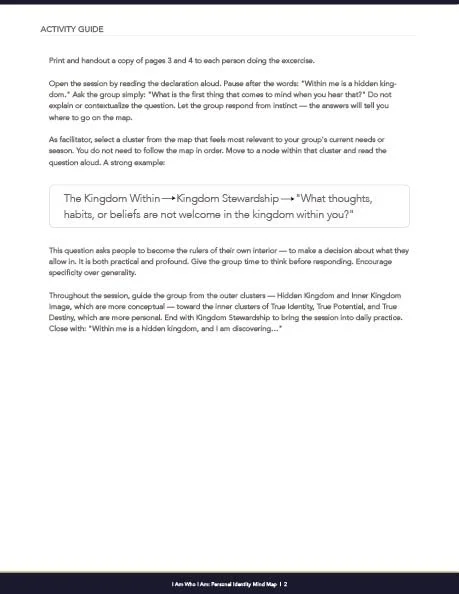
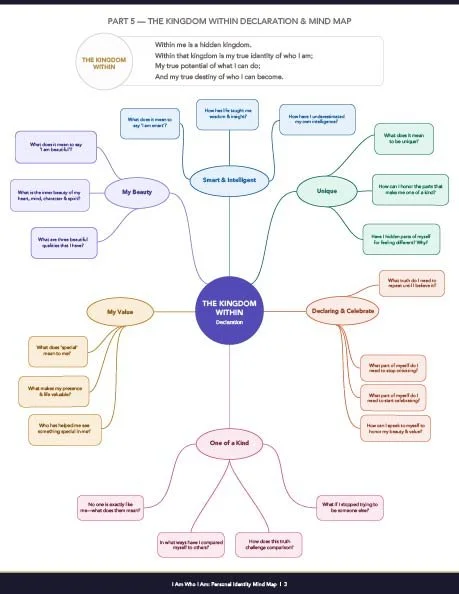
Part 5 of the I Am Who I Am series is a group facilitation experience built around one of the most profound and least explored ideas in personal development: that within every person is an interior world — a kingdom — that contains their true identity, their true potential, and their true destiny. Not a future version of themselves they have yet to become. Not a possibility contingent on circumstances finally aligning. But a living reality already present within them, waiting not to be created but to be discovered.
The work of this session is not inspiration. It is excavation. It is the careful, honest, sometimes uncomfortable process of going beneath the surface of a life — beneath the noise, the performance, the protection, and the pain — to find what has always been there.
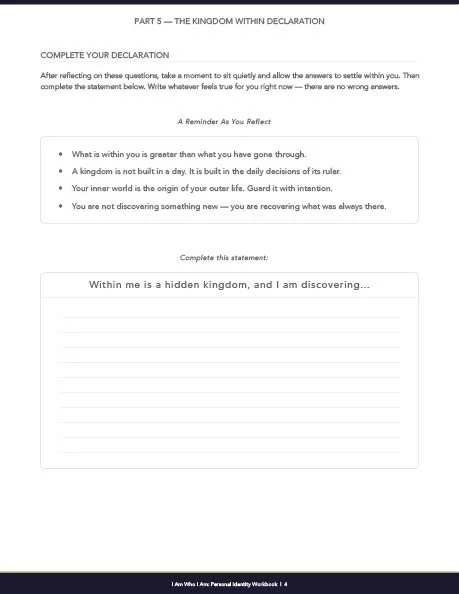
The Part 5 bundle includes a Mind Map for group facilitation and a Reflection Worksheet for personal written exploration. Together they form a complete guided experience — one that moves a group from the familiar territory of outer life management into the often uncharted and deeply rewarding territory of inner life discovery.
The Mind Map — Group Facilitation Tool
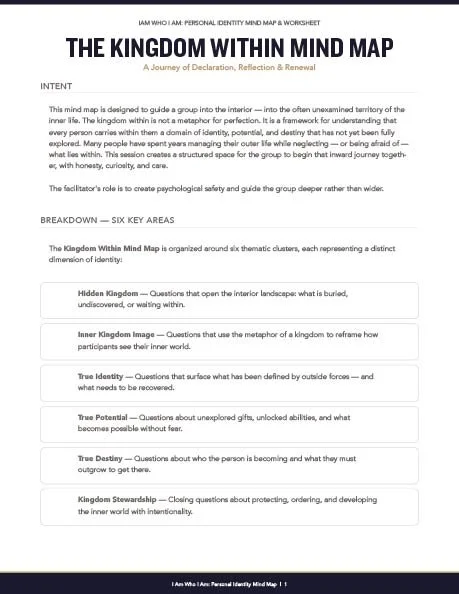
The Kingdom Within Mind Map is a visual facilitation tool that organizes the 25 reflection questions into six thematic clusters arranged around a central core. Unlike a linear curriculum, this map is designed to be navigated in response to the group — entering from wherever the conversation is most alive, pressing deeper when the group is ready, and allowing the natural interior arc of the session to move from the conceptual toward the deeply personal.
Who This Is For
For participants: Anyone who has spent years managing the outside of their life while feeling increasingly unfamiliar with the inside. Anyone who has survived something significant and is still trying to understand what it did to them — and what it did not destroy. Anyone who has a persistent, quiet sense that there is more within them than what has been expressed, developed, or believed — and who is finally ready to go looking for it. Anyone who has asked the question Is this all I am? — and suspected, even hoped, that the answer is no.
For facilitators: Therapists, counselors, life coaches, spiritual directors, pastoral leaders, retreat facilitators, organizational development consultants, educators, and mentors working with individuals or groups who are navigating identity questions, personal transformation, spiritual growth, or the long, nonlinear process of becoming who they were always meant to be. This resource provides a structured, repeatable framework for guiding groups into interior territory with safety, intentionality, and depth.
For groups: Healing and recovery communities, spiritual formation groups, leadership development cohorts, women's empowerment circles, men's growth groups, young adult programs, university student organizations, grief and transition support groups, faith communities, and any gathering of people who are willing to move beyond the surface of their lives — and who are ready to discover together what has been hidden within each of them all along.
Format: PDF
Page Count: 4 (Not including Cover)
Group Activity Guide
What This Is
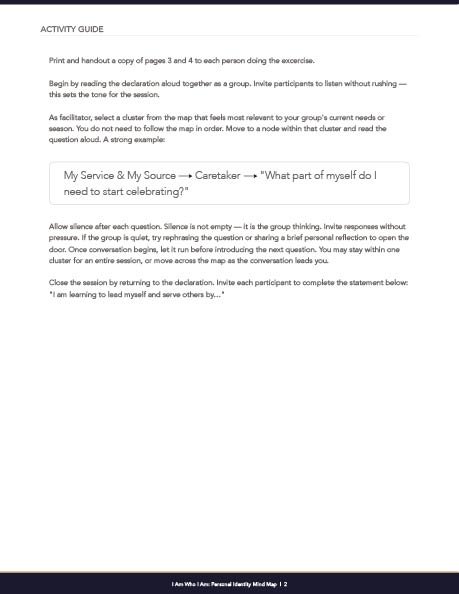
There is a version of service that looks generous on the outside but is quietly destroying the person giving it. It is the service that comes from the need to prove worth. The helping that never stops because stopping feels like failure. The giving that has no source behind it — no well to draw from, no place to return to, no foundation beneath the output. It looks like devotion. It feels like depletion.
This resource exists to examine that pattern honestly — and to offer something different.
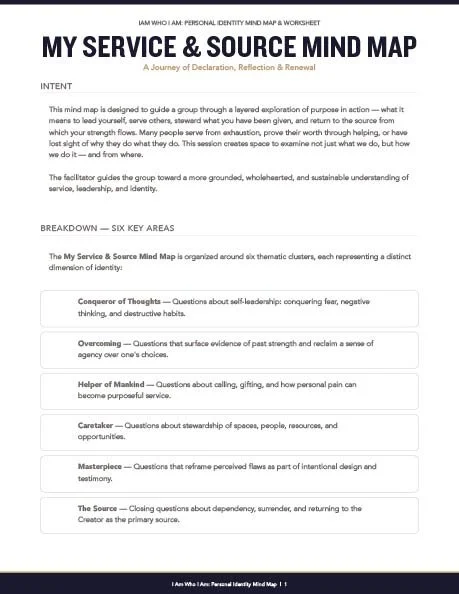
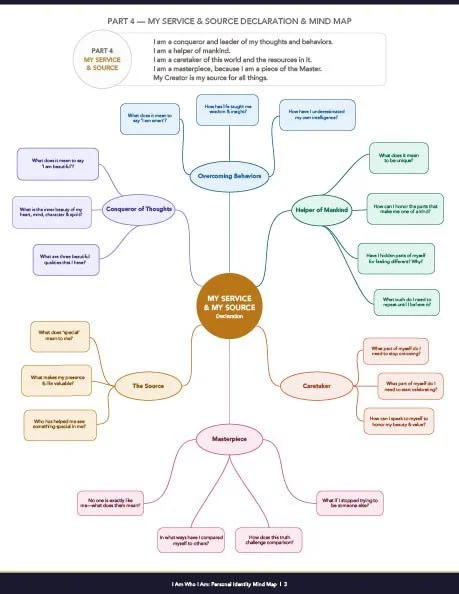
Part 4 of the I Am Who I Am series is a group facilitation experience that moves through four interconnected dimensions of a life lived with purpose: self-leadership, service, stewardship, and source. It does not begin with what you do for others. It begins with how you lead yourself — because a person who cannot govern their own thoughts, habits, and behaviors will eventually serve others from a place of emptiness, prove their worth through exhaustion, and mistake activity for purpose.
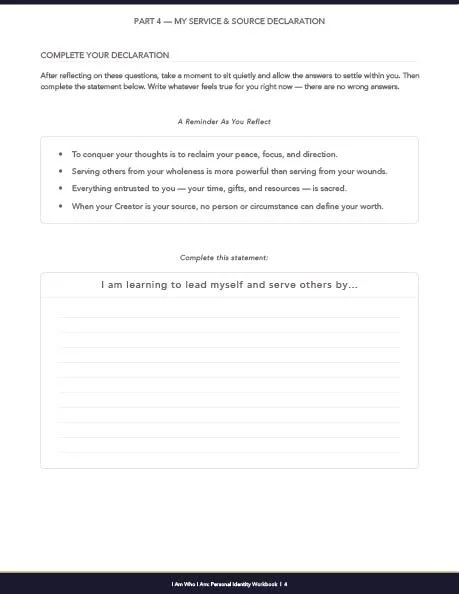
The Part 4 bundle includes a Mind Map for group facilitation and a Reflection Worksheet for personal written exploration. Together they form a complete guided experience — one that moves a group from the question of what do I do into the far more important questions of how do I lead myself, why do I serve, what have I been entrusted with, and where am I drawing my strength from.
The Mind Map — Group Facilitation Tool
The My Service & My Source Mind Map is a visual facilitation tool that organizes the 25 reflection questions into six thematic clusters. It is not a curriculum to be delivered in sequence. It is a map to be navigated — the facilitator moving through it in response to what the group surfaces, pressing into the areas where the conversation goes quiet, and following the energy where it is most alive.
Who This Is For
For participants: Anyone who has been serving from exhaustion rather than overflow. Anyone who has built their identity around what they do for others and lost sight of who they are apart from it. Anyone who has been trying to lead others — a family, a team, a community, a congregation — while privately struggling to lead themselves. Anyone who has been drawing from sources that are running dry and is ready to examine honestly what they have been depending on, and what a more sustaining foundation might look like.
For facilitators: Counselors, life coaches, ministry leaders, nonprofit directors, human resource professionals, organizational development consultants, therapists, educators, and community leaders working with people in helping professions, leadership roles, or seasons of burnout and transition. This resource provides a structured framework for guiding groups into honest conversation about the internal cost of service, the foundations of sustainable giving, and the relationship between self-leadership and purposeful contribution.
For groups: Nonprofit teams, ministry staff, healthcare workers, educators, social workers, community organizers, leadership cohorts, pastoral teams, caregiver support groups, entrepreneurship communities, and any group of people who give significantly of themselves — and who need a structured space to examine honestly whether they are giving from a place of wholeness or depletion, calling or compulsion, source or survival.
Format: PDF
Page Count: 4 (Not including Cover)
Group Activity Guide
What This Is
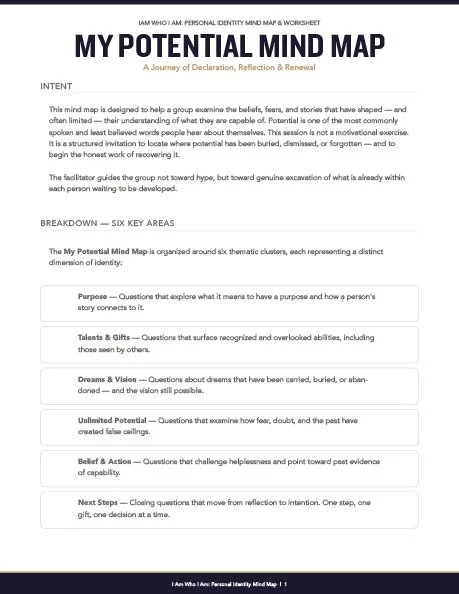
Potential is one of the most spoken and least believed words in the human experience. People hear it from teachers, coaches, parents, and mentors. They nod when it is said about them. And then they quietly return to the life they have already decided is the limit of what they are capable of.
This resource exists to interrupt that pattern.
Part 3 of the I Am Who I Am series is a group facilitation experience centered on excavation — not motivation. The goal is not to inspire people with possibility and send them home feeling temporarily energized. The goal is to help a group locate exactly where their potential has been buried, what buried it, and what it would take to begin recovering it. That is slower, more honest, and far more lasting work than inspiration alone.
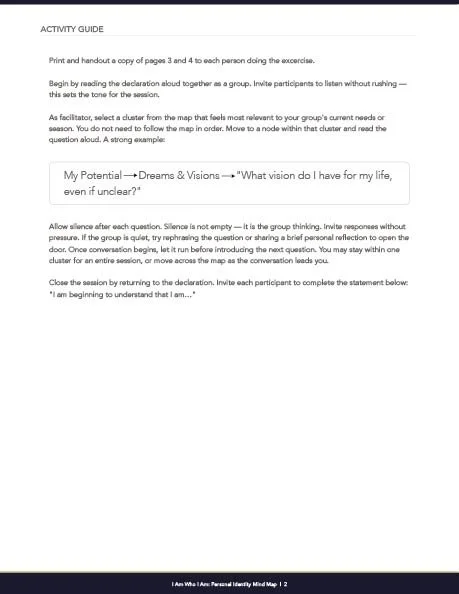
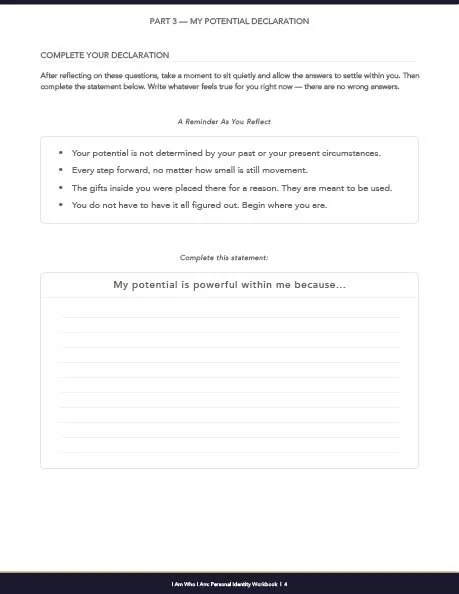
The Part 3 bundle includes a Mind Map for group facilitation and a Reflection Worksheet for personal written exploration. Together they form a complete guided experience — moving a group from the surface question of what can I do into the deeper questions of what have I stopped believing I can do, and why.
The Mind Map — Group Facilitation Tool
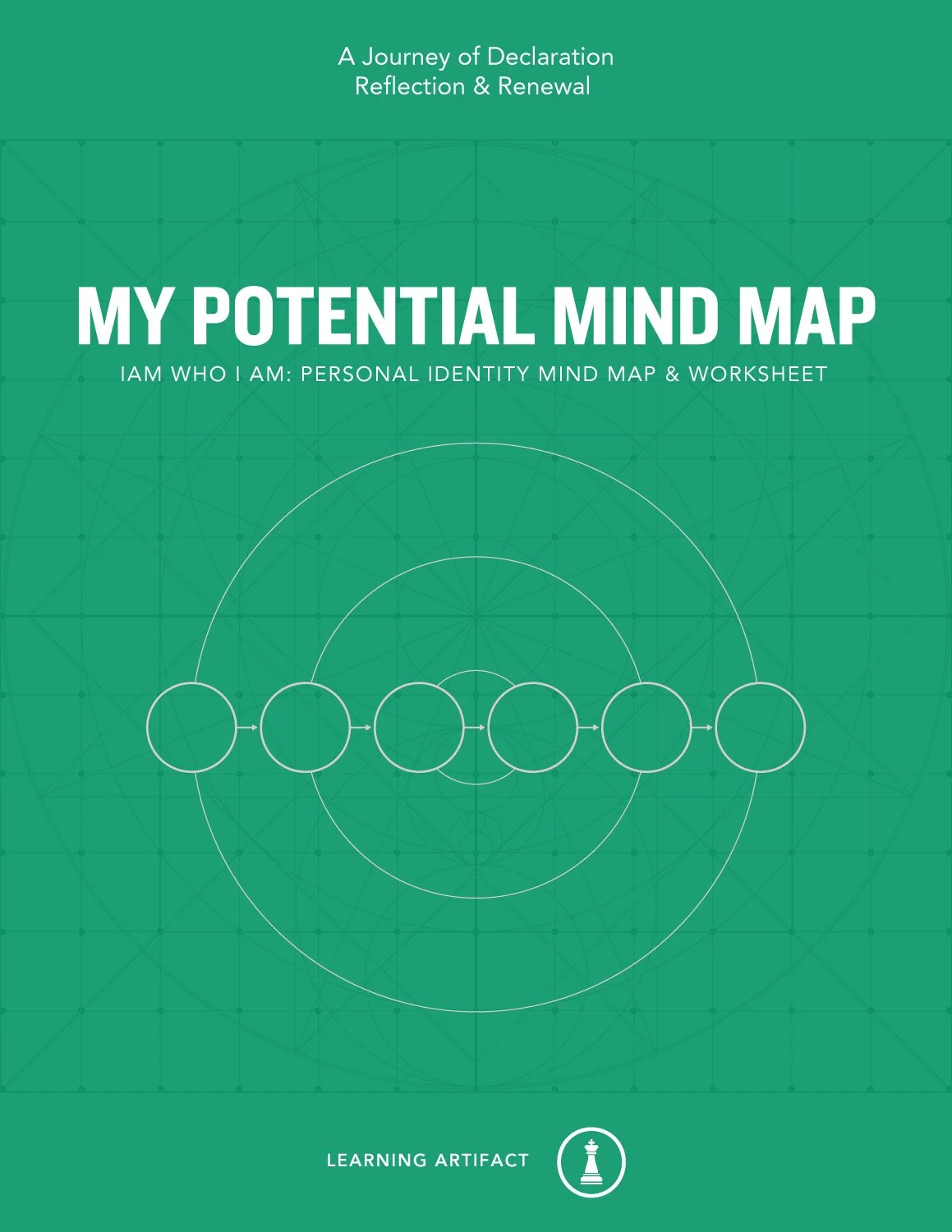
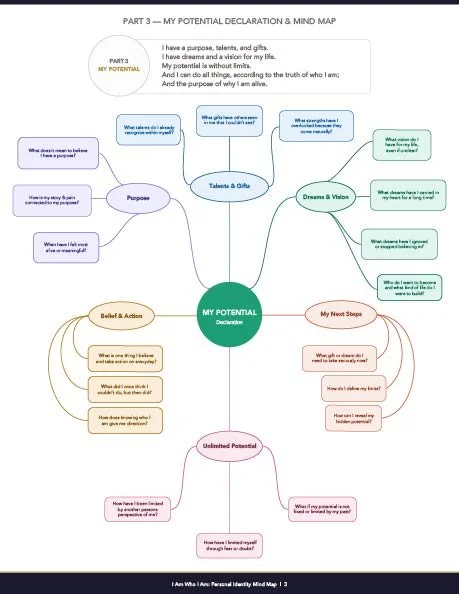
The My Potential Mind Map is a visual facilitation tool that organizes the 24 reflection questions into six thematic clusters. It is a navigational instrument designed to be moved through in response to the group, following the conversation where it leads and pressing into the areas where the resistance is greatest.
Who This Is For
For participants: Anyone who has been living beneath their own capacity for so long that it has started to feel normal. Anyone who has a dream they have not spoken aloud in years because hope has become too risky. Anyone who has been told they have potential by others but has never quite been able to take up residence in that belief themselves. Anyone who is ready — not to be motivated — but to be honest about what has been in the way, and to begin the real work of removing it.
For facilitators: Counselors, life coaches, career coaches, educators, mentors, youth workers, pastors, group therapists, and community leaders who work with people navigating transitions, recovering from setback, or trying to locate direction in a season of uncertainty. This resource provides a structured, repeatable framework for guiding groups into honest conversation about capacity, limitation, and the specific internal barriers that keep potential theoretical rather than lived.
For groups: Career development cohorts, entrepreneurship programs, recovery communities, student organizations, leadership development groups, reentry programs, faith communities, mentorship circles, and any group of people who are willing to be honest with each other about the gap between who they are and who they know they could become — and who are ready to begin closing it.
Format: PDF
Page Count: 4 (Not including Cover)
Group Activity Guide
What This Is
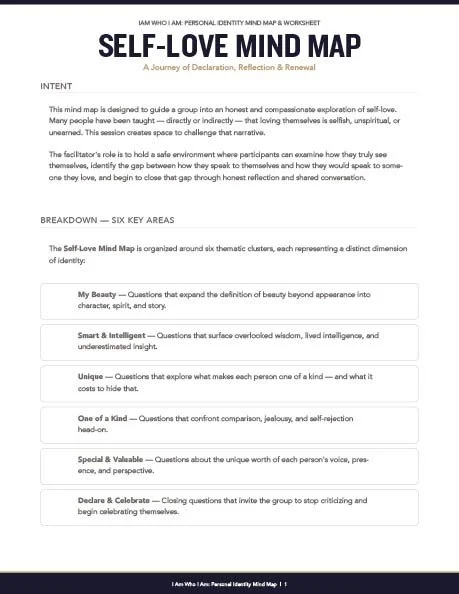
Most people have been taught — directly or indirectly — that loving themselves is something they have to earn. That it is conditional. That it comes after the weight is lost, the mistake is fixed, the approval is won, or the wound is healed. This resource exists to challenge that belief at the root.
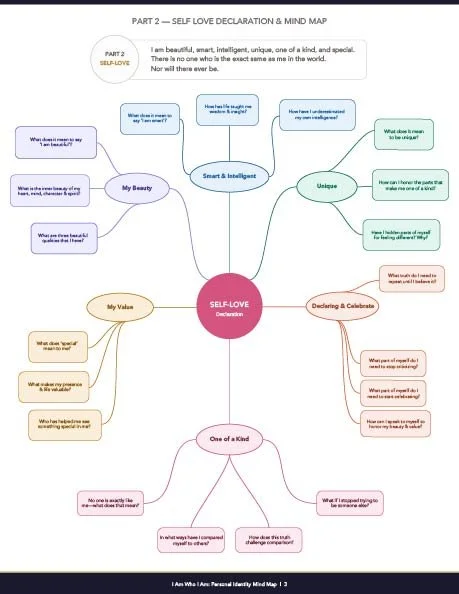
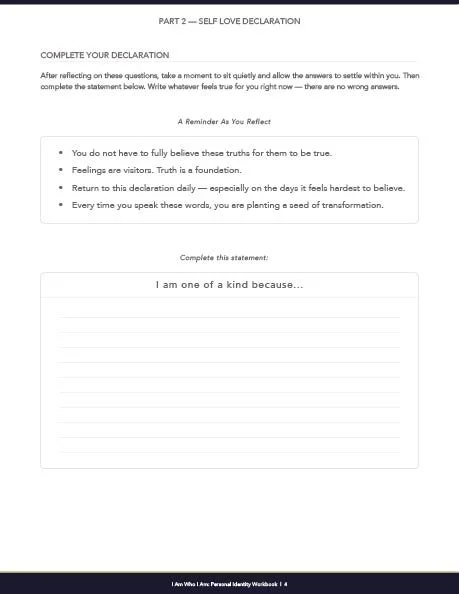
Part 2 of the I Am Who I Am series is a group facilitation experience built around one of the most quietly revolutionary declarations a person can make: I am beautiful, smart, intelligent, unique, one of a kind, and special — and there is no one in the world exactly like me.
The Part 2 bundle includes a Mind Map for group facilitation and a Reflection Worksheet for personal written exploration. Together they create a complete guided experience — one that moves a group from surface-level conversation into honest, transformative dialogue about how they truly see themselves, and what it would take to begin seeing themselves differently.
How to Facilitate
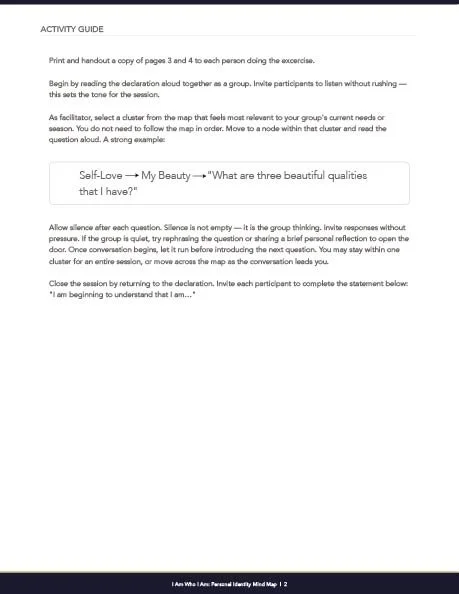
Begin by reading the declaration aloud as a group. Then ask: "Which word in that declaration is hardest for you to say about yourself right now?" Do not move past this question quickly. The answers will tell you exactly where the group is — and where the map needs to take them.
Navigating the Map
Select a cluster based on what surfaces in the opening. You do not need to cover every cluster in a single session. It is far better to go deep into two clusters than to skim across all six. Choose a node within your selected cluster and read the question aloud. A strong example:
Self-Love → One of a Kind → "In what ways have you compared yourself to others instead of appreciating who you are?"
Holding the Space
Self-love is tender territory. Some participants will have spent decades being told — by people they trusted, by institutions they belonged to, by the voice in their own head — that they are not enough. When someone shares something vulnerable in this session, resist the urge to fix it, reframe it too quickly, or move to the next question. Let the group witness each other. That witnessing is itself an act of healing.
Redirecting the Conversation
If the conversation drifts into self-criticism or comparison, gently redirect with curiosity rather than correction: "Where do you think that belief came from?" or "What would it look like to see that part of yourself differently?" These questions create movement without dismissing what was shared.
Closing the Session
End by inviting each participant to speak one thing they are choosing to celebrate about themselves — something specific, not general. Then close together with the completion statement:
I am one of a kind because…
Encourage participants to finish that sentence out loud if the group has built enough trust, or in writing if the session calls for more privacy.
Format: PDF
Page Count: 4 (Not including Cover)
Group Activity Guide
What This Is
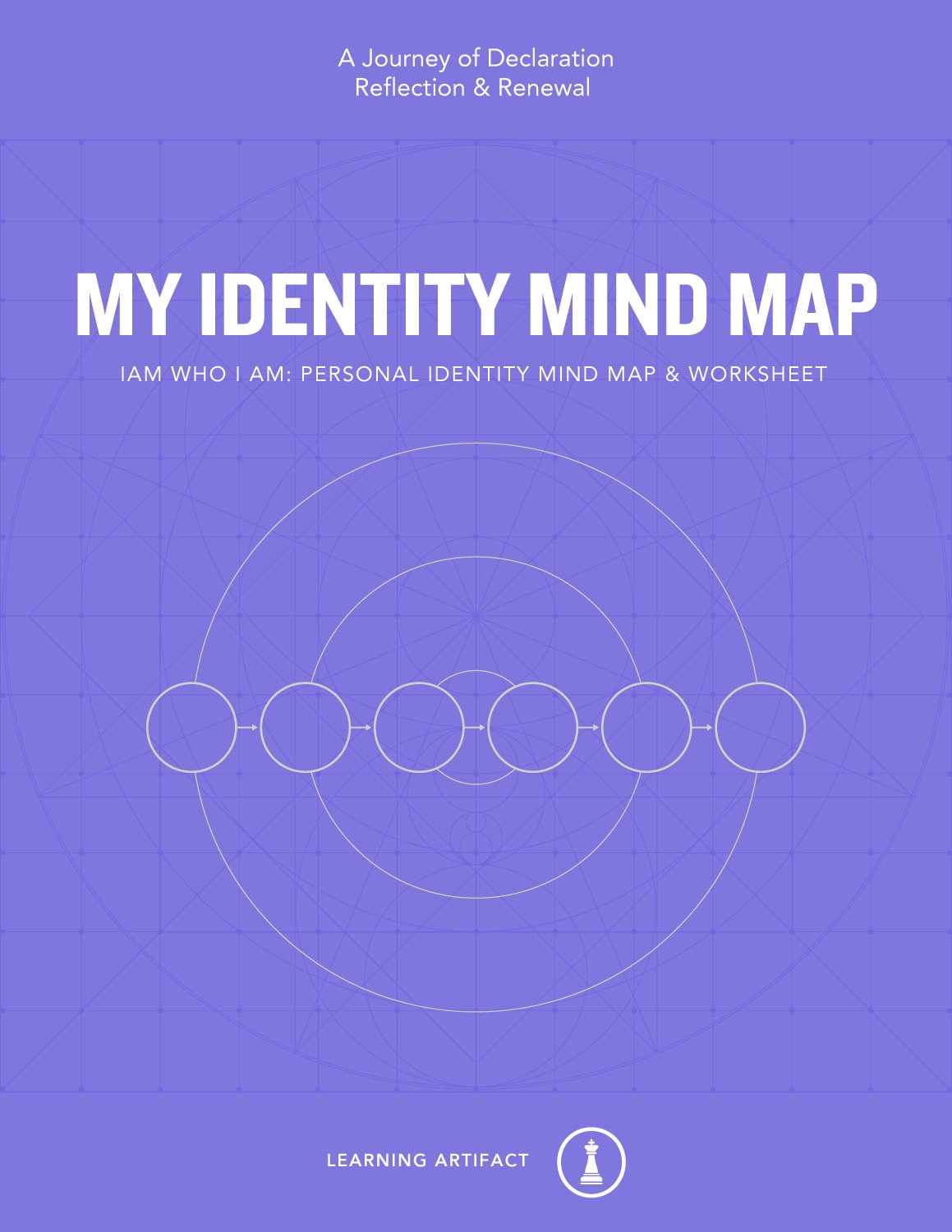
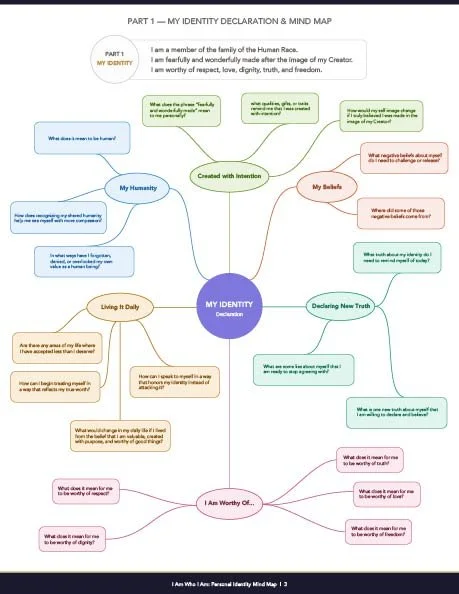
This is a single-part exploration from the I Am Who I Am series — a focused, standalone tool for anyone ready to examine the most fundamental question a person can ask: Who am I?
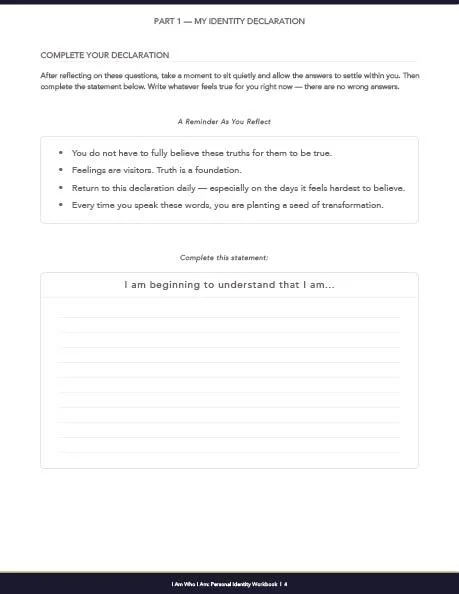
The Part 1 bundle includes two complementary resources designed to work together: a Mind Map for group facilitation and guided conversation, and a Reflection Worksheet for personal, in-depth written exploration. Whether you are using both together or one at a time, the experience is the same — a structured, intentional journey into the truth of your identity.
The Mind Map — For Groups & Facilitated Conversation
The My Identity Mind Map is a visual facilitation tool designed for group settings — workshops, small groups, classrooms, counseling sessions, team retreats, or any space where intentional conversation about identity can take place.
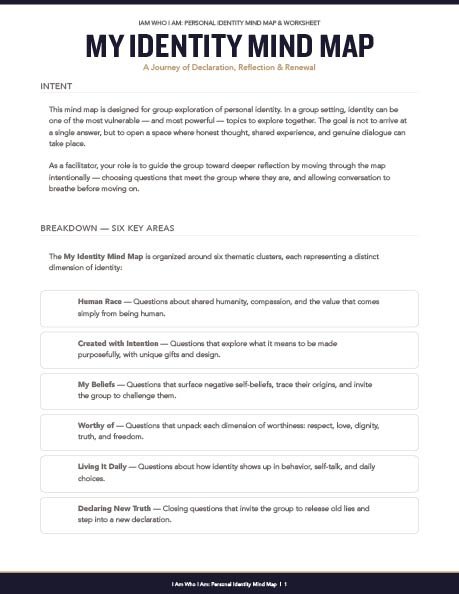
The map organizes 20 reflection questions into six thematic clusters, each representing a distinct dimension of identity:
Human Race — What it means to belong to humanity, and how recognizing shared humanity opens the door to self-compassion
Created with Intention — What it means to be fearfully and wonderfully made — and what gifts, qualities, and traits point to purposeful design
Beliefs — The negative beliefs that diminish self-image, where they come from, and how to begin replacing them with truth
Worthy of… — A focused exploration of each dimension of worthiness: respect, love, dignity, truth, and freedom
Living It Daily — How identity shows up — or fails to show up — in daily behavior, self-talk, and personal standards
Declaring New Truth — The closing cluster, where old lies are named and released, and a new truth is chosen and declared
How a Facilitator Uses It
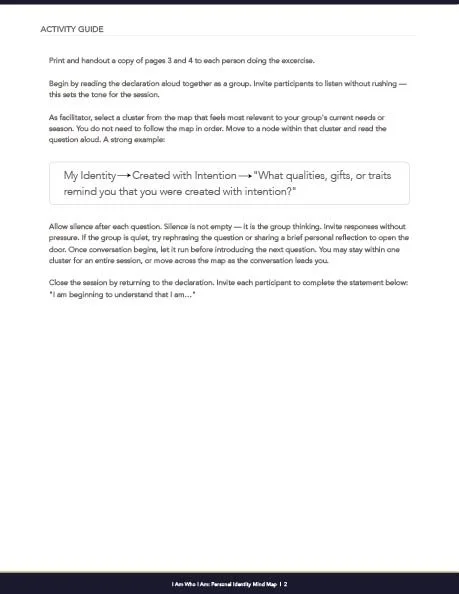
The facilitator selects a cluster that meets the group's current needs, moves to a specific node within that cluster, and presents the question to the group. A strong example:
My Identity → Created with Intention → "What qualities, gifts, or traits remind you that you were created with intention?"
The map is not meant to be followed in order from start to finish. It is a navigation tool — designed to be moved through intuitively, following the conversation where it naturally goes and pressing deeper when the group is ready.
Who This Is For
This resource is for anyone who has ever struggled to answer the question Who am I? with confidence, clarity, or peace.
It is for the person who has spent years being defined by what they have been through — by trauma, by failure, by the labels others placed on them — and is ready to examine whether those definitions are actually true. It is for the facilitator, counselor, coach, pastor, teacher, or group leader who wants a structured, meaningful tool for guiding others into honest self-examination. It is for the individual working quietly and privately through the long process of rebuilding a self-image that has been broken down over time.
It is for anyone who suspects there is more to who they are than what they have been told — or than what they have allowed themselves to believe.
A Note On How To Use It
There is no right pace. Some people will move through all 20 questions in a single sitting. Others will spend an entire week on a single question. Both are correct. The goal is not completion — it is discovery.
Read the declaration aloud before you begin. Return to it when the questions feel heavy. Let the words settle before you move on to the next one. Write freely, without editing yourself. The most honest answers are rarely the ones that come first.
No results match your search. Try removing a few filters.